

Compare
Almost everybody sells you a record.
Very few sell you the money back.
Three kinds of software already exist for Indian healthcare and each is genuinely good at something. This is what each one is for, where it stops, and the one gap that runs through all three.
Patient marketplaces
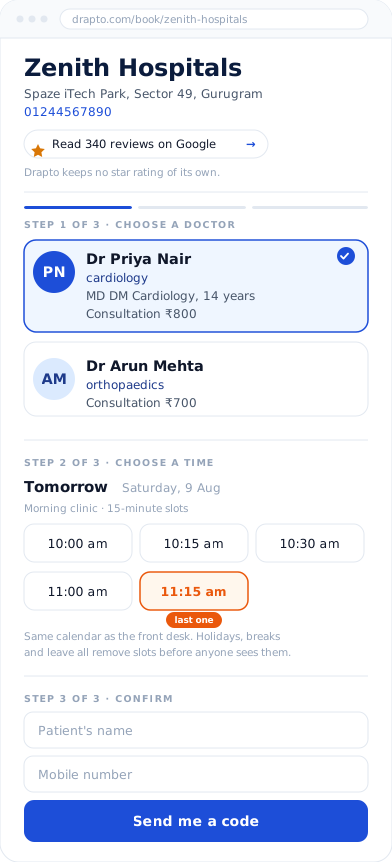
Consumer apps that hold the patient relationship and rent it back to you. Genuinely good at reach — they have the audience and the app installs.
Where it stops: you pay per patient or for placement, the relationship is theirs, and it ends when you stop paying. Nothing in the model touches what a payer deducts from you eight weeks later.
HMS and EMR suites
The large category. Appointments, records, billing, pharmacy, sometimes labs. Mature, feature-complete, and what most hospitals in India actually run.
Where it stops: a billing module records what happened. It tells you the claim was reduced; it does not tell you the reduction was predictable at admission and could have been prevented.
Enterprise platforms
Built for large groups — multi-branch, deep configuration, long implementations. If you are 500 beds across six cities, this category exists for you.
Where it stops: cost and time to value. A 40-bed hospital does not have nine months and a project team, and the deductions are happening this month.
The gap that runs through all three
Every category above records the claim. Recording a deduction and preventing one are different products, and the second is the one that pays for itself.
| What it does | Marketplace | HMS / EMR | Enterprise | Drapto |
|---|---|---|---|---|
| Books patients and holds the record | Yes | Yes | Yes | Yes, free |
| Raises the claim | No | Yes | Yes | Yes |
| Tells you a deduction happened | No | Yes | Yes | Yes |
| Models the room cap before admission | No | Rarely | Sometimes | Yes |
| Scores claim risk before submission | No | Rarely | Sometimes | 24 rules |
| Reads the settlement advice for you | No | Rarely | Sometimes | Yes |
| Charges per patient or for placement | Yes | No | No | Never |
| Free tier that is not a trial | Partial | Rarely | No | Permanent |
Columns describe the category, not any one company. Individual products vary and change — check the specific vendor you are comparing us to, and hold us to the same standard.
When you should not choose us
Said plainly, because a page that claims to win every comparison wins none of them.
Pick something else if
- You want somebody to send you new patients — we have no audience to rent
- You need deep multi-speciality configuration across 500 beds today
- You want it white-labelled under your own brand
- Your bottleneck is demand, not leakage
Pick us if
- You bill insurers and cannot itemise what you lost
- You want the patient-facing half without a per-appointment fee
- You want to be live this quarter, not next year
- You would rather be shown twenty of your own settled claims than a demo
In more depth
What runs without being asked
Improved most weeksA cancellation is offered to the next person in order, with a window, until somebody takes it.
Raised when the prescription is written, chased twice, then it stops. It does not nag.
An abnormal value escalates after thirty minutes if nobody named has acknowledged it.
Twenty-four rules, scored before submission and sorted by exposure rather than raw risk.
Ctrl-K from any screen. These are database queries, so they work offline and cost nothing.
Ask in your own words. Bring your own Anthropic or OpenAI key, or run Ollama on your hardware and nothing leaves the building.
We are deliberate about which is which. Most of what runs here is rules, not a model — because a rule is auditable, works when the connection drops, and cannot invent a figure. We build and improve both every week, and we will always tell you which one answered you.
Questions we are actually asked
Both, and the distinction matters. The clinical and patient-facing half is free forever. What hospitals pay for is revenue integrity — modelling a room-cap deduction before admission rather than reporting it eight weeks later.
Yes. Many hospitals keep the system their staff know and add the revenue integrity layer next to it, rather than replacing anything.
No, and you should be suspicious of anyone who says they do. We have no patient audience to rent. What we do is stop you losing the patients you already have.
Almost everybody sells you a record.
Very few sell you the money back. Recording a deduction and preventing one are different products.
The honest version of the comparison.
We have written down what we will not claim, which is the part most comparisons leave out.