

They rent you the patient.
You never get to keep them.
A marketplace has the audience and the app installs, and that is a real asset. The question is what you are left holding when you stop paying.
| Question | A marketplace | Your own page |
|---|---|---|
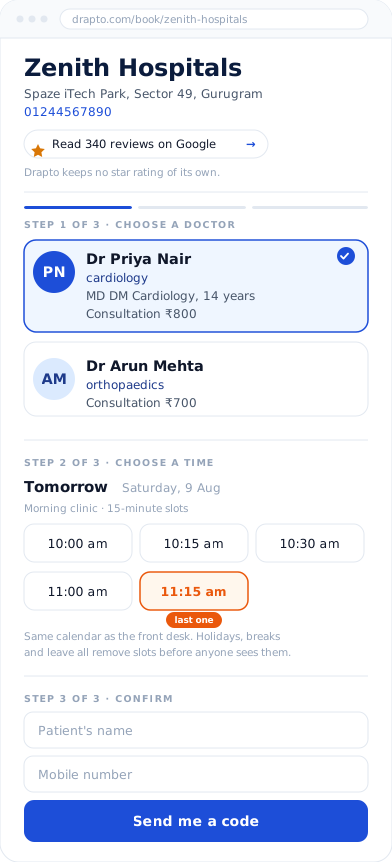
| Who does the patient think they booked with | The app | You |
| What happens when you stop paying | You disappear | Nothing. It is yours |
| Can somebody outbid you for position | Yes | No. Alphabetical |
| Who holds the patient record | They do | The patient, then you |
| Cost per booking | A fee or a commission | Zero |
| Star ratings from unverified accounts | Usually | None hosted, ever |
The three-year arithmetic
What a marketplace is genuinely better at
- Cold reach in a city where nobody knows you
- App installs and a consumer habit you cannot build alone
- Being found by somebody who has no doctor at all
What it cannot do
- Stop a payer deducting from you eight weeks later
- Give you a patient who stays when you leave the platform
- Answer a referral, chase a follow-up or refill a cancelled slot
This describes a category, not a named product. Individual vendors differ and change — check the one you are actually considering, and hold us to the same standard.
The structural difference
Whose customer is the patient?
Everything else follows from this. A marketplace owns the patient and rents them back. Drapto never touches the relationship.
A marketplace
- The patient is theirs; you rent access
- Ranking is purchasable
- A commission on each consultation
- Your competitor advertises on your listing
- Leaving means losing the patients
Drapto
- The patient books you directly
- Nobody can pay to appear above you
- no share of an in-person consultation, ever
- No advertising anywhere on your page
- Export on demand, no fee
We are not claiming marketplaces are useless — they bring volume a new clinic cannot get otherwise. We are saying the incentive is structural, and it does not soften.
What runs without being asked
Improved most weeksA cancellation is offered to the next person in order, with a window, until somebody takes it.
Raised when the prescription is written, chased twice, then it stops. It does not nag.
An abnormal value escalates after thirty minutes if nobody named has acknowledged it.
Twenty-four rules, scored before submission and sorted by exposure rather than raw risk.
Ctrl-K from any screen. These are database queries, so they work offline and cost nothing.
Ask in your own words. Bring your own Anthropic or OpenAI key, or run Ollama on your hardware and nothing leaves the building.
We are deliberate about which is which. Most of what runs here is rules, not a model — because a rule is auditable, works when the connection drops, and cannot invent a figure. We build and improve both every week, and we will always tell you which one answered you.
They rent you the patient.
And you lose them the month you stop paying. A page of your own keeps working.
The honest version of the comparison.
We have written down what we will not claim, which is the part most comparisons leave out.