

Nadi
Ask your own data. Get a number, not a paragraph.
Ctrl-K anywhere in Drapto. Every answer comes from your records with the query it ran shown underneath.
Nadi · the command bar
Press Ctrl-K. Ask your own data a question.
Not a chatbot in a corner. A command bar on every screen, which is a different thing: a chatbot is a place you go, and a command bar is something you press where you already are — mid-round, mid-claim, mid-argument with a payer.
Figures shown are test-suite values. The link under every answer is the point of this page.
The command bar
claims6 admissions over the eligible room categorythis week
amountExposure if each is settled proportionately₹11,40,000
openStill admitted — room can still be changed2 of 6
sourceRoom eligibility rule, tariff v4, admission recordsview
exportSend this list to the billing deskCSV
Ctrl-K from any screen. It reads what you already have and shows you where the answer came from — it does not act on it.
The line that matters
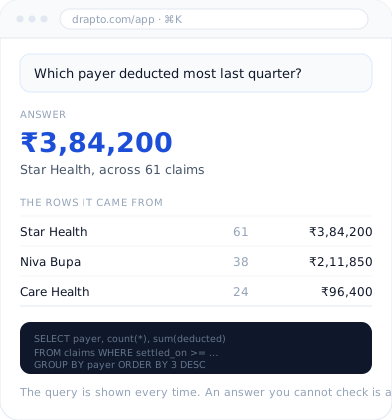
She never invents a figure, and every answer links to the screen it came from.
Every product in this category says “AI-powered”. Almost none of them will tell you what happens when the model does not know. In a hospital that question is not academic: an assistant that produces a plausible number is worse than no assistant, because somebody will act on it, and they will act on it faster than they would have acted on a spreadsheet.
Produces an answer shaped like the right answer. When it does not know, it produces one anyway, in the same confident register as when it does.
The arithmetic runs first, deterministically, over records already in your account. The model explains and prioritises what the arithmetic found. It is not the thing computing the number.
Which is why every answer carries a link to the screen it came from. Not a citation to a document — a link to the worklist, the register, the claim. If Nadi says ₹1,50,000 is recoverable, one click shows you the claim, the payer and the days left, and you can disagree with the screen rather than with the assistant.
The test to apply to any assistant, including this one. Ask it something your data cannot answer. If it produces a confident figure rather than saying the data is not there, you have learned everything you need to know about the numbers it gives you on the days you are not testing it.
Why a command bar and not a chatbot
The questions worth asking arrive while you are doing something else.
Nobody opens a chat window to ask whether the equipment is due for service. The question occurs during a round, in the middle of a different task, and the cost of leaving that task to go and ask is higher than the value of knowing. So it goes unasked, and the answer surfaces three weeks later as a problem.
On every screen
The same key, everywhere in the workspace. There is no page you have to navigate to first, which is the whole point.
It knows where you are
Asked from a claim, a question about “this patient” means that patient. Context is the difference between a command bar and a search box.
It answers, it does not act
Nadi shows you what is true and links you to the screen where you can change it. It does not submit claims, alter records or send anything on your behalf.
What it can answer
Twenty-six skills, across everything the workspace already holds.
Not the open web, and not medical knowledge in general. Your admissions, your claims, your contracts, your registers, your equipment, your schedules.
Whose key, whose data
It runs on your AI key, which means you can switch it off.
Your provider, your model, your usage
The key is yours and encrypted at rest. You choose the provider and you see the usage, rather than paying us a margin on somebody else's inference.
Turning it off changes nothing else
Every other part of Drapto keeps working. An assistant that cannot be removed is a dependency, not a feature — and a hospital should be able to decide that separately.
Two more assistants share the same rule. Decoder reads a settlement advice for your billing manager, and Sahayak explains a rejection letter to a patient. Neither invents a figure either, and Sahayak will not predict the outcome of a claim.
What it will not do
The limits, because an assistant’s limits are the useful part of the spec.
No clinical advice. Nadi does not diagnose, does not suggest treatment and does not interpret results. It answers operational and financial questions about your own workspace.
No prediction dressed as fact. No recovery percentages, no likelihood that a claim will succeed, no NABH readiness score. Where an answer is an estimate, it says so; where the data is not there, it says that instead of filling the gap.
It does not act on your behalf. Nothing is submitted, altered or sent by Nadi. It shows you what is true and takes you to the screen where a person decides.
It is part of the paid product. The whole patient-facing half of Drapto is free forever; this is not in it.
Twenty-four answers with no AI key at all
What it is actually asked
| You type | It opens |
|---|---|
| who has not been read | Unacknowledged lab results |
| who should I ring today | No-show risk for tomorrow |
| what is unpaid | Collections, oldest first |
| who has not come back | Overdue follow-ups |
What we will never do
Things we have promised not to do
- Take a cut of a consultation fee
- Charge per appointment
- Sell a position in the directory
- Host star ratings
- Move a free thing behind the paywall
How we are actually paid
- Hospitals, for revenue integrity
- Companies, for corporate health
- Labs and pharmacies, for their modules
- Implementation, because it is somebody’s week
- Nothing from a patient, ever
One room or two hundred beds.
What runs without being asked
Improved most weeksA cancellation is offered to the next person in order, with a window, until somebody takes it.
Raised when the prescription is written, chased twice, then it stops. It does not nag.
An abnormal value escalates after thirty minutes if nobody named has acknowledged it.
Twenty-four rules, scored before submission and sorted by exposure rather than raw risk.
Ctrl-K from any screen. These are database queries, so they work offline and cost nothing.
Ask in your own words. Bring your own Anthropic or OpenAI key, or run Ollama on your hardware and nothing leaves the building.
We are deliberate about which is which. Most of what runs here is rules, not a model — because a rule is auditable, works when the connection drops, and cannot invent a figure. We build and improve both every week, and we will always tell you which one answered you.
Ask it something your reports cannot answer.
Ctrl-K, a question in plain English, and the query it ran shown underneath.