

Corporate health · a shared service for hospital groups and employers
Eligibility is only real if the person at the point of care can see it.
A company can offer an excellent benefit and still lose trust at the reception desk. When coverage is not visible in the workflow, the safe answer is to collect first and resolve it later. Drapto gives teams the answer before the experience breaks.
Drapto puts the eligibility check where the money is being asked for. The desk can see that this employee is covered, for what, and until when — before the receipt is printed.
A connected programme needs both sides: the hospital workflow and the employer experience. This page is designed for an enterprise planning conversation.
Why a hospital runs this
One signature. Four patients.
The employee your contract covers does not come alone. When the first visit works — eligibility answered at the desk, nothing to pay, a record they keep — the spouse’s dental appointment, the father’s follow-up and the child’s vaccination land at the same front desk. You paid to acquire none of them.
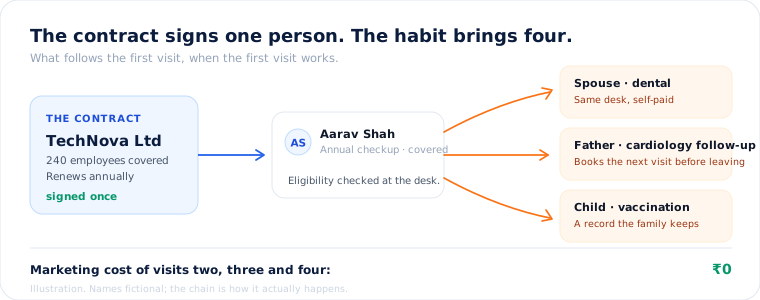
Hospital teams can serve covered employees correctly; employer teams can understand programme value without receiving clinical data.
Eligibility, limits and the correct billing path are visible when the team needs them.
Participation, adoption and commercial performance are visible without compromising privacy.
Where hospitals and employers meet
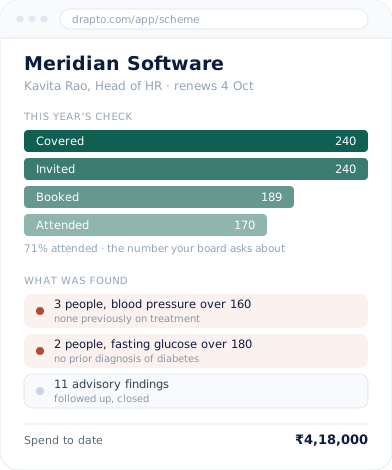
The two sides are sold separately and meet in one place: a corporate contract a hospital already honours at its front desk is the same contract an employer is already paying for. Illustrative of the product structure, not of any customer deployment.
Why this is structurally hard for anybody else
A booking platform cannot tell a receptionist not to take money.
“This is covered. Do not collect at the desk.”
That sentence needs a billing relationship with the hospital. A discovery platform does not have one — it can route a patient to you, and then it stops. The moment eligibility has to be enforced against an actual bill, it is out of the loop.Which is why corporate empanelment usually degrades into paperwork: a PDF list of eligible employees at reception, updated monthly if anyone remembers, and a reconciliation argument at the end of the quarter about who should have been charged.
Drapto is already the system raising the bill. Eligibility is checked in the same place the charge is created, which is the only place the answer changes anybody’s behaviour.
The question every HR director asks first
What the employer can see, and what they will never be shown.
This is the part that decides whether a company signs, and most corporate health products answer it vaguely. An employee who suspects their employer can see their diagnosis will not use the benefit, and a benefit nobody uses is worse than no benefit — the company paid for it and the workforce got nothing.
So the boundary is drawn explicitly, and it is drawn in the software rather than in a policy document.
HR can see
Administration, and only administration
- Who is on the eligibility roll, and until when
- That an employee attended a health check — attendance, not findings
- Campaign uptake: how many were invited, how many came
- Invoiced amounts against the empanelment, as amounts
- The statutory register entries the law requires them to hold
- Workforce-level patterns, aggregated so no individual is identifiable
HR is never shown
Anything clinical about a named person
- A diagnosis, ever
- A prescription, or that one was written
- Lab values, or which tests were ordered
- Consultation notes, or which doctor was seen
- What a bill was for — the amount, never the treatment
- Anything at all from a visit the employee made outside the campaign
The employee’s record belongs to the employee, not to the
employer. Their results and history live at their own /my/<token>
address, alongside every other clinic they use. It survives them leaving the company, the
company leaving the hospital, and the hospital leaving Drapto. Nobody can delete it, including
us.
How a company actually gets used
Empanelment is easy. Attendance is the hard part.
Most corporate tie-ups produce a signed agreement and very little footfall. The letter goes out, a few people come, and at renewal nobody can say whether it worked. The steps below are the ones that decide whether it does.
- Eligibility, loaded and current Who is covered, for what, and until when — kept current rather than as a spreadsheet emailed in January and still in use in October.
- The health-check campaign Invitations go out, employees book themselves, and the clinic sees the load coming rather than discovering it on the day.
- The check at the desk Reception sees coverage before the charge is raised. This is where the benefit becomes real to the employee, and where a wrongly-collected payment is prevented rather than refunded.
- The employee’s own results Lab values, over time, with direction, at their own address. They keep them; the employer does not receive them.
- The statutory register The occupational-health records the company is required to hold, produced as a by-product of doing the work rather than assembled the week before an inspection.
- The funnel, honestly reported Invited, booked, attended, completed. Four numbers that tell a company whether the benefit it bought is reaching anybody, and tell the hospital where it is losing them.
No figures on this page. We do not publish uptake rates, attendance percentages or revenue-per-empanelment, because no outcome data exists yet and a number invented for a marketing page would be the first thing a procurement team checks.
Why hospitals hold on to this
A company with four hundred employees empanelled does not switch casually.
Switching means re-papering
A new agreement, a new eligibility load, a new set of HR contacts and a fresh explanation to the workforce. That is a project, not a procurement decision.
The relationship sits with the company
Not with an intermediary who can move it. The hospital holds the empanelment directly, and Drapto is the software underneath rather than a party to it.
It compounds with everything else
The same platform is already running intake, billing and the claims side. Corporate eligibility is a check inside a workflow that exists, not a separate system to reconcile.
The public addresses involved
What an employee or an HR contact actually opens.
Both are token-addressed, need no account, and are excluded from search
engines in robots.txt.
| Address | Who opens it | What it does |
|---|---|---|
/hr/<token> | The HR contact | Eligibility roll, campaign uptake and invoiced amounts. Nothing clinical about any named employee. |
/checkup/<token> | An employee | Their health-check invitation. They book their own slot. |
/result/<token> | An employee, or any patient | A lab result, released to the person it belongs to. |
/my/<token> | The employee, permanently | Their own record across every clinic, with lab values over time. Theirs, not the employer's. |
What this will not do
The limits, because a procurement team will look for them.
It is not an insurance product. Drapto is not an insurance advisor, broker or agent and is not registered with IRDAI in any such capacity. Corporate health here means an empanelment between a company and a hospital, not a policy.
We do not sell or broker employee data. Not to insurers, not to pharma, not to advertisers, not aggregated and not as a research dataset. There is no version of this product where the workforce is the revenue.
We will not surface an individual’s clinical data to an employer on request, under contract, or as a paid feature. It is not a setting, which means nobody can be talked into turning it on.
We publish no outcome figures. No uptake benchmark, no attendance rate, no revenue-per-empanelment. When there is real data and a customer willing to be named, it will appear with their name on it.
What we will never do
Things we have promised not to do
- Take a cut of a consultation fee
- Charge per appointment
- Sell a position in the directory
- Host star ratings
- Move a free thing behind the paywall
How we are actually paid
- Hospitals, for revenue integrity
- Companies, for corporate health
- Labs and pharmacies, for their modules
- Implementation, because it is somebody’s week
- Nothing from a patient, ever
One room or two hundred beds.
Start with the half that pays for itself.
What runs without being asked
Improved most weeksA cancellation is offered to the next person in order, with a window, until somebody takes it.
Raised when the prescription is written, chased twice, then it stops. It does not nag.
An abnormal value escalates after thirty minutes if nobody named has acknowledged it.
Twenty-four rules, scored before submission and sorted by exposure rather than raw risk.
Ctrl-K from any screen. These are database queries, so they work offline and cost nothing.
Ask in your own words. Bring your own Anthropic or OpenAI key, or run Ollama on your hardware and nothing leaves the building.
We are deliberate about which is which. Most of what runs here is rules, not a model — because a rule is auditable, works when the connection drops, and cannot invent a figure. We build and improve both every week, and we will always tell you which one answered you.
Start with the half that pays for itself.
Corporate contracts first. The clinical side is an addition, never a precondition.