

Home / Hospitals
Revenue cycle management for Indian hospitals
The deduction happens at admission. Now you see it there.
TPA and insurance claim management that starts at the front desk: room caps, pre-auth clocks, coding and payer tariffs checked while the room can still change — not eight weeks later, when it is an appeal.
Room cap breached · no consent on file
Pre-auth clock at 18h of 24h
Package billed with components
Code in notes, missing from bill
Illustration with sample figures from the Drapto test workspace.
- ABDM · ABHA at the desk
- NHCX · FHIR R4 bundles
- ICD-10 coding engine
- NABH evidence
- DPDP Act 2023
- Indian data centres
- On-premise or managed
Billing teams fight deductions at settlement. Drapto prevents them at admission.
Across the claim
Every rupee has a moment it could still be saved.
Drapto works at each of those moments, inside the workflow your desk and wards already follow.
- At admissionRoom cap & eligibility
Entitlement checked against the policy; the proportionate deduction modelled before the room is allotted; the best zero-deduction room offered first, consent recorded by name.
- During the stayPre-auth & enhancement
Notification clocks per payer, not a hard-coded 24 hours. Enhancement flagged at 85% of the approved amount.
- At codingDeterministic ICD-10
Indian clinical shorthand coded offline in about a millisecond; documentation gaps raised before the summary leaves the ward.
- Before you send24-rule claim score
Documentation, authorisation, identity, timing, money and payer history — sorted by rupee exposure, not raw risk.
- After settlementEvery line, read
The settlement advice split into predictable, contractual and unexplained deductions. The last one is your query list.
Capabilities
Everything a hospital revenue team needs. Nothing it has to re-key.
Room-cap modelling
Proportionate deduction priced per payer before the patient is admitted.
Explore →Pre-auth clocks
Per-payer windows, escalation before expiry, drafts from the chart.
Explore →Tariffs & empanelment
Rate cards per contract; billing above agreed rates flagged before send.
Explore →Denial & appeal worklist
Short-paid claims sorted by time left, with the appeal letter one click away.
Explore →Claims Decoder
Paste a settlement advice; see what was disallowed and what was predictable.
Explore →PM-JAY & state schemes
PM-JAY, CGHS, ECHS, ESIC and the state schemes across 17 regions, mapped.
Explore →Inside Drapto
The screens a hospital opens every day.
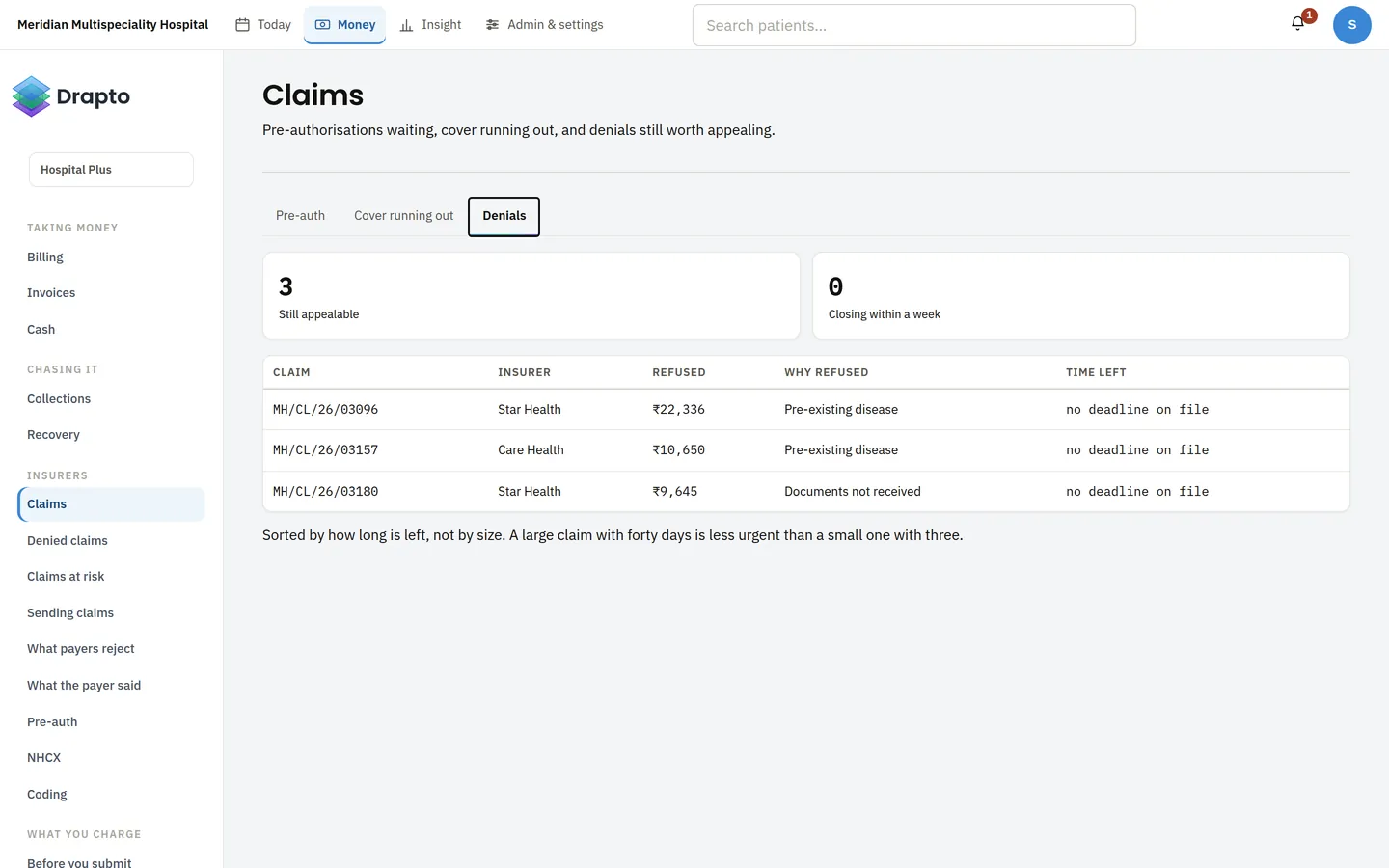


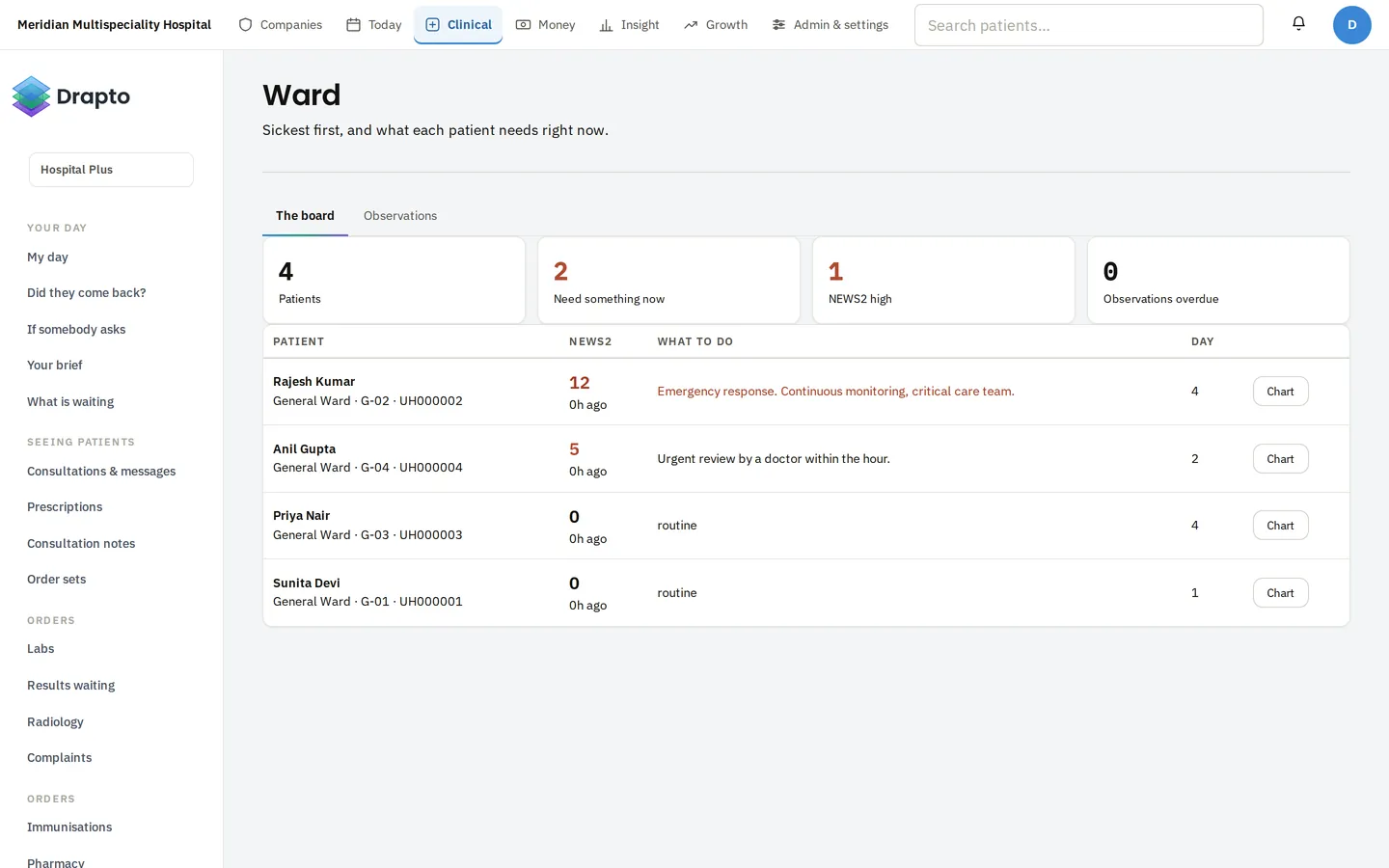
Demo workspace · sample names and figures, not customer data.
Who uses it
One record. Four very different questions.
Leakage per bed-day
Where the hospital is losing money, by branch, payer and department.
The unexplained figure
Not the total shortfall — the part no stated reason accounts for.
What to fix today
Pre-auth clocks, open queries and appeals, sorted by exposure.
Coding & documentation
Gaps raised while the patient is still in the ward.
Go-live
Live in one to five weeks. On top of your HIS.
Weeks 1–2 · up to 30 beds
Records migrated, payer contracts and tariffs loaded, room caps configured, pre-auth clocks set per payer.
Weeks 3–5 · 31–100 beds
Multi-payer rate cards, scheme packages, NHCX readiness and department-level roles, rolled out by department.
Groups
Branch by branch, with one contract set applied to every branch and one record per patient across them.
Questions
Asked before every demo.
Is Drapto revenue cycle management software?
Yes — for the part of the revenue cycle Indian hospitals actually lose money in: eligibility and room caps at admission, pre-authorisation and enhancement clocks during the stay, coding and claim scoring before submission, and settlement reconciliation after. Billing itself stays in your HIS.
Which insurers, TPAs and schemes does it handle?
The major Indian insurers and TPAs, PM-JAY and the state schemes, CGHS, ECHS and ESIC. Payer rules, tariffs and packages are kept per contract, so the same procedure is checked against the agreement that actually applies.
Will it work with our existing HIS?
Yes. Drapto runs alongside your HIS and imports what it needs from its exports. There is no rip-and-replace.
Do you publish recovery percentages?
No. We have no outcome data we would put our name to yet, and we will not invent one. In the demo we show you the mechanism on your own payers and you judge it.
How long does go-live take?
One to two weeks up to 30 beds, three to five weeks up to 100 beds, rolled out by department.
Does it submit claims to NHCX?
Drapto builds and validates NHCX FHIR R4 claim bundles. Transmission runs through your own NHA onboarding.
See it against your own payers.
A free 30-minute demo on your room categories and TPAs — then a written proposal sized to your beds.
Questions? enquiry@drapto.com