

The product
Seven screens, drawn from the real interface.
Not marketing renders. Each one is the screen a receptionist, a doctor or an administrator actually opens.
Interactive platform tour · real operating moments
See how the connected healthcare enterprise works.
Follow the moments that shape a better healthcare operation: a patient entering care, a clinician acting safely, a finance team seeing risk early, and an employer programme earning trust.
Each figure below is an illustration drawn from the live interface and the values the test suite produces. Not a screenshot. Nothing invented for effect. Every patient name fictional.
drapto.com/book/zenith-hospitalsFor the patient · no account
Every clinic already has a booking system. It is a phone, and it only works when somebody is free to answer it.
Which means the appointments a clinic loses are the ones somebody tried to make at 9pm, or during the lunch rush, or while the receptionist was on the other line. The clinic never finds out. It just has a quieter Tuesday.
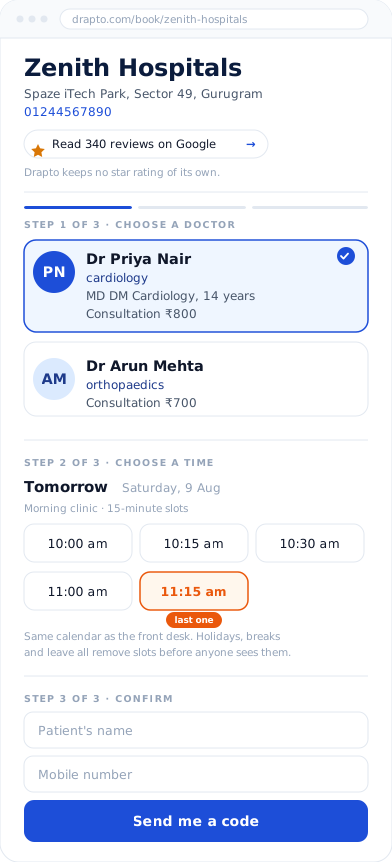
So the clinic gets an address of its own — one it can put on a board, a WhatsApp status, the bottom of a prescription pad. A patient opens it and books. No download, no login, no account to create.
- The slots are the real slots
- They come from the same calendar the front desk reads. Holidays, breaks and leave remove them before anyone is offered a time the clinic is shut.
- “Last one” only when it is
- Shown when a slot has one place left, and not otherwise. On every slot it is noise; on the last one it is a reason to press now.
- The reviews are Google’s, not ours
- Read 340 reviews on Google is a link out. Drapto keeps no star rating of its own, because a rating we control is a rating we could sell.
What it will not do. A phone code is required before a slot is held. It is friction, and it is deliberate — without it a public booking form is a spam target inside a week, and the damage is not junk rows, it is held slots that no real patient can take.
For the doctor
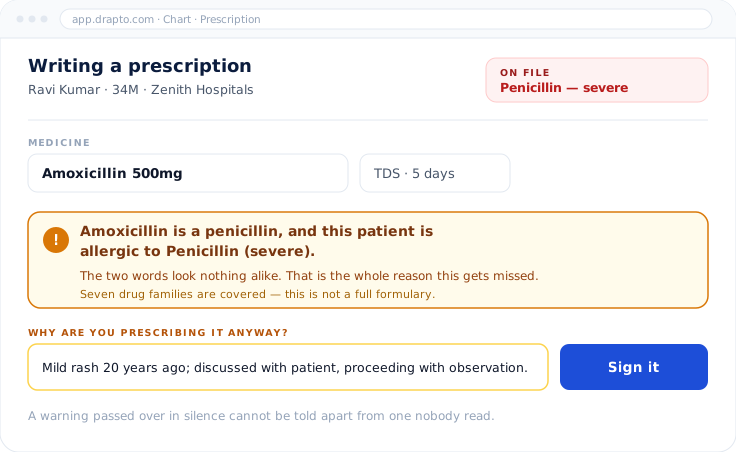
“Allergic to penicillin” and “prescribing amoxicillin” look nothing alike, which is exactly why this gets missed.
Nobody prescribes a drug they know the patient reacts to. What happens is that the allergy was recorded eleven months ago by somebody else, in a different word, and the connection between the two names is a piece of pharmacology the person holding the pen is not thinking about at 4:40pm with nine people waiting.
The warning does not block anything
A doctor may have a very good reason — a mild rash two decades ago, a discussion already had with the patient, an observed course. Refusing the prescription would be software overruling a clinician on a judgement it is not qualified to make.
What is refused is overriding in silence
Because a warning passed over without a word cannot be told apart from one nobody read. The reason typed into that box is the entire difference between a decision and an accident, and it is the thing anyone reviewing the chart later actually needs.
What it will not do. Seven high-value drug families, not a full formulary. Real interaction checking needs a licensed drug database under licence, and claiming coverage we do not have would be worse than the gap itself — a doctor who trusts a check that is not there is more dangerous than one who knows to look.
For the patient
“TDS” saves the doctor two seconds and costs the patient five days of the wrong thing.
The abbreviation is a convention between prescribers. To almost everybody else it is three letters. A patient who reads it as twice daily, or as take when distressed, takes the wrong dose for the whole course and reports back that the medicine did not work.
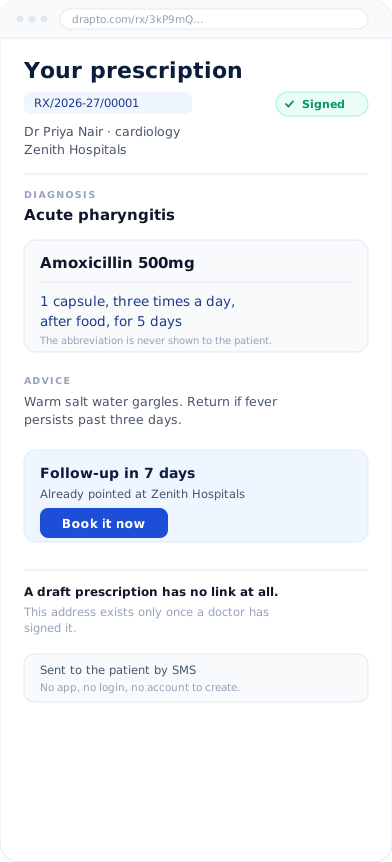
So it is spelled out, in the words the patient would use: 1 capsule, three times a day, after food, for 5 days. The doctor still enters TDS. The patient never sees it.
- The follow-up is one tap, on the same page
- The appointment a doctor asks for is the one most often never made. Here it sits on the prescription, already pointed at the right clinic and the right doctor.
- The number is a real number
RX/2026-27/00001— financial-year series, sequential, and the same reference the clinic can search on when the patient rings about it.
What it will not do. A draft prescription has no link at all. The address does not exist until a doctor has signed it, which means there is no window in which a half-written prescription can reach a patient by accident.
drapto.com/rx/<token>For the owner
One number tells a hospital it is owed money. Three tell it what to do this morning.
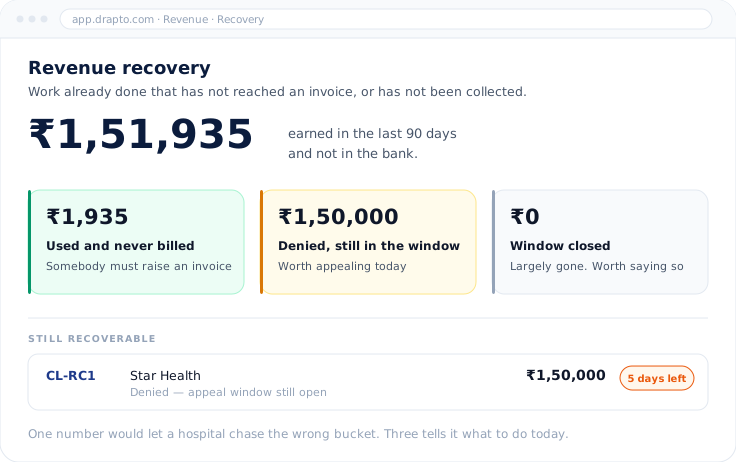
Outstanding revenue is not one problem. Work that was done and never invoiced needs somebody in billing to raise a bill. A claim denied inside its appeal window needs a letter this week. A claim whose window shut needs nothing at all, because it is gone. Presenting those as a single total invites a hospital to chase the wrong one.
₹1,935 — never billed
Consumables used and work completed that never reached an invoice. Recoverable in full, by someone raising the bill. This is a process fix, not a negotiation.
₹1,50,000 — still open
Denied, appeal window still running. CL-RC1, Star Health, five days left.
This is the figure that decides what a billing manager does before lunch.
₹0 — window closed
Past the deadline and largely gone. Saying so plainly is more useful than folding it into a total that makes a hospital feel richer than it is.
What it will not do. Nothing on this screen is an estimate. Every figure is arithmetic over records already in the account, which is why it can be tied back line by line — and why it will show ₹0 rather than a projection when there is nothing there.
For the assessor
A hospital that thinks it is at 94% is worse off than one that knows which register is empty.
Most compliance software shows a green dashboard, because a green dashboard is what gets bought. The trouble is that the missing six per cent is not distributed evenly across the standards. It is concentrated in the ones where nothing has ever been recorded, and those are exactly the ones an assessor will ask about.
So there is no score. There is a list of standards, the question an assessor actually asks for each one, and one of three states: evidenced, records with gaps, or no records at all. The hospital that reads this can prepare. The one reading a percentage finds out in the room.
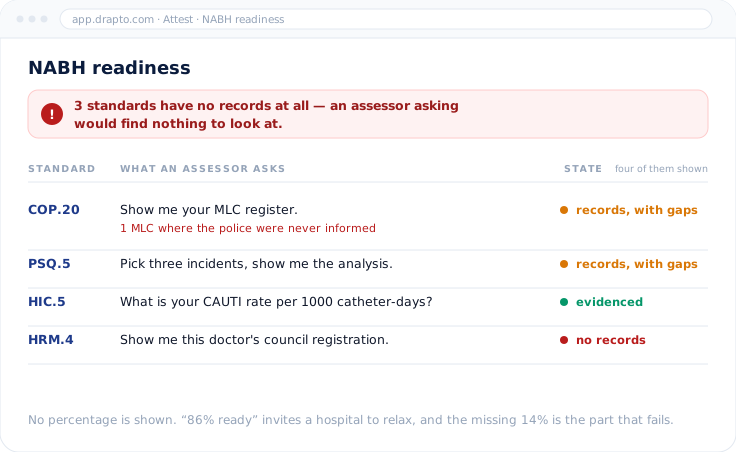
The gap is named, not counted
Not “COP.20 — 80%” but 1 MLC where the police were never informed. One of those is a grade. The other is a thing somebody can go and fix before Friday.
The question is the assessor’s question
Show me this doctor’s council registration. Written the way it will actually be asked, so that preparing for the screen is preparing for the assessment rather than for the software.
What it will not do. There is no readiness percentage anywhere in the module, and there will not be one. Drapto also cannot tell a hospital it will pass — only which standards currently have nothing behind them.
drapto.com/referral/<token>Doctor to doctor
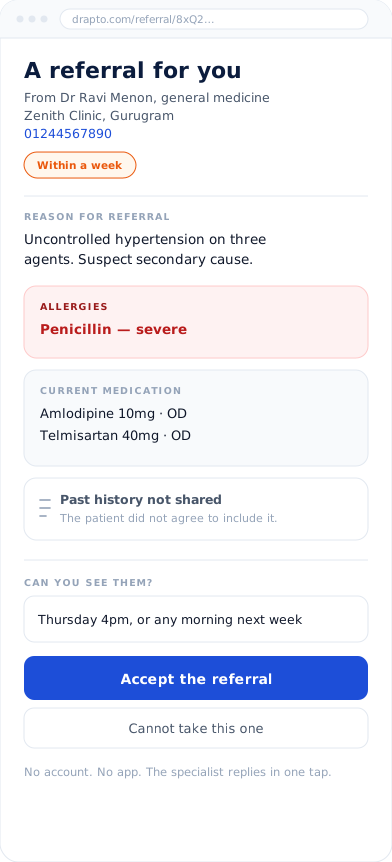
The referral that never gets answered is the one that asked a busy specialist to create an account first.
A referral is a favour between two doctors who are both behind. Anything that stands between the specialist and a yes or no — a signup, an app, a password reset at 10pm — converts into the referring doctor ringing them a week later to ask whether they got it.
So the specialist gets a link. They read the reason, the allergies, the medication, and they either offer a time or say they cannot take it. One tap, no account.
- What was withheld is stated, not left blank
- Past history not shared. Otherwise a specialist cannot tell an empty medication list from a withheld one, and rings the referring doctor anyway — which is the phone call the whole thing existed to prevent.
- The urgency is a word, not a colour
- Within a week. A red dot means whatever the sender was feeling. A timeframe means the same thing to both doctors.
What it will not do. Anything beyond the reason for referral needs the patient’s agreement first. A referral carrying somebody’s medication list without their say-so is not a referral, it is a disclosure — so the sections they declined travel as a labelled absence rather than as data.
For the patient · one link, for years
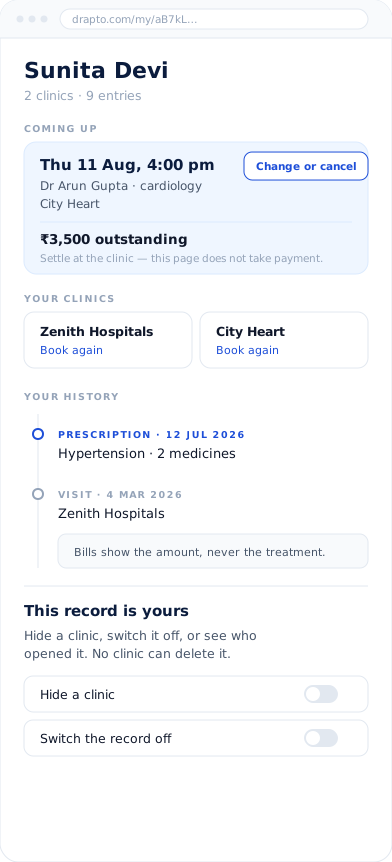
A hospital’s file belongs to the hospital. The patient gets a photocopy, if they ask nicely.
Which is why most people’s medical history lives in a plastic folder, and why the second clinic starts from nothing. The record here is not the hospital’s file with patient access bolted on. It is the patient’s, and it accumulates across every clinic they visit.
What is coming up sits above the history, because that is what somebody opening the link actually wants to know — the appointment on Thursday, the ₹3,500 still owed, the button to change it without ringing anybody.
- It is genuinely theirs
- They can hide a clinic from their own timeline, switch the record off entirely, and see who has opened it. No clinic can delete it, including the one that created it.
- Bills show amounts, never treatments
- ₹3,500 outstanding, not what it was for. A line item on a screen held by someone standing next to a relative is a disclosure the patient did not choose to make.
What it will not do. The page does not take payment. The balance is shown so the patient is not surprised at the desk; settling it happens at the clinic, with the clinic, and Drapto is not in the middle of it.
drapto.com/my/<token>Intake · where appointments come from
Six ways an appointment gets made. One calendar it lands in.
A clinic does not have a booking channel. It has six, and five of them are invisible to whoever is looking at the day sheet. The patient who booked online, the one who walked in, the follow-up written on a prescription, the referral a specialist accepted, the patient re-booking from their own record, and the one the front desk entered by hand — these are the same scarce thing being allocated by six different people who cannot see each other.
/book/<clinic> — patient picks the doctor and the slot/my/<token> — book again at a clinic they have usedDay, week and month views, filtered per doctor. Room allocation across the day. Recurring series — daily, weekly, monthly. A six-stage status flow from booking to completion. And no-shows as a measured number rather than an impression.
Capacity is the one thing a clinic cannot sell twice. An unpaid balance can be chased next month; an empty 10:15 is gone.
Cancelling frees the slot
Immediately, and back into the pool the public page reads from. A cancellation that only tells the clinic is a slot nobody can take.
Walk-ins get a number, not a guess
The queue number is issued at the desk and visible. It does not make anybody wait less; it makes the wait a known quantity instead of an argument.
No-shows are counted
Which turns “we are quite busy” into a figure, and a figure into a decision about overbooking, reminders, or neither.
What it will not do. Drapto does not sell placement. /find
is a search, not a ranking, and no clinic can pay to appear higher in it — which also
means it will never send a clinic patients it did not already earn. Discovery here is a
consequence of having a page worth landing on, not a product we meter.
The conversational layer
Three assistants, because “ask the hospital anything” is not a job anyone actually has.
A billing manager reading a settlement advice, a nurse looking for an equipment schedule, and a patient holding a rejection letter want three different things from three different bodies of knowledge. One chatbot spanning all three is a chatbot that is vague at all of them.
Nadi · for hospital staff
Answers from the workspace, across every module
Claims, coding, compliance registers, equipment schedules, NABH standards. Seven skill areas, and it works from data already in the account rather than from the open web.
Decoder · for the billing manager
Reads a settlement advice line by line
Takes what the payer sent and says which deductions were predictable, which were contractual, and which the payer never actually explained.
Sahayak · for the patient
Explains a rejection letter in plain words
What the ground of rejection means, what it does not mean, and what the patient can do next. It does not tell them they will win.
The arithmetic runs first, the model second
Figures are calculated deterministically from the records, and the model is used only to explain and prioritise what the arithmetic already found. An assistant that can invent a number is worse than no assistant, because a clinic will act on it.
It runs on the clinic’s own key
Your AI provider, your model choice, encrypted at rest, your usage. Which also means a clinic can turn the whole layer off and keep every other part of the product working.
What it will not do. None of the three gives clinical advice, and Sahayak will not predict the outcome of a claim. There is also no patient-to-doctor chat product here — conversations attach to the patient’s timeline as a record of what was said, not as a consultation channel, and Drapto is not a teleconsultation platform.
The public surface
Every address a patient or a referred doctor can open without an account.
All of it on drapto.com. These are the real routes the
application serves today, not a roadmap.
| Address | Who opens it | What it does |
|---|---|---|
/find |
Anybody looking for a clinic | Search by name, city or speciality. Not a ranking — nobody pays to appear higher. |
/book/<clinic> |
A patient booking | The clinic’s own page. Server-rendered, so a crawler sees the clinic rather than a loading spinner. |
/appointment/<token> |
A patient who booked | Change or cancel without ringing. Cancelling frees the slot immediately. |
/rx/<token> |
A patient with a prescription | Signed prescriptions only — a draft has no link at all. |
/my/<token> |
A patient, for years | Everything, every clinic. Nothing shows until they confirm their number by code. |
/referral/<token> |
A specialist, with no account | Read the referral, accept it, offer a time. |
/sitemap.xml · /robots.txt |
Search engines | Public clinic pages in. Every application page out. |
Drapto never takes the consultation fee. Payments a patient makes go to the clinic. The clinic pays a subscription and nothing per patient, per appointment or per claim — a busy month should not produce a bigger invoice from us.
About the seven figures on this page
Each one is an illustration, drawn by hand in SVG from the real page markup and the real API output. None of them is a screenshot, and none has been retouched to look better than the screen does.
Every figure, reference and line of dosage text is a value the test suite
produces: ₹1,51,935 outstanding, ₹1,935 unbilled,
₹1,50,000 denied with five days left on claim CL-RC1,
RX/2026-27/00001, “Read 340 reviews on Google”, “1 capsule,
three times a day, after food, for 5 days”. Nothing on this page was invented for
effect.
No patient data appears anywhere. Ravi Kumar, Sunita Devi, Dr Priya Nair, Dr Arun Mehta, Dr Arun Gupta, Dr Ravi Menon, Zenith Hospitals, Zenith Clinic and City Heart are all fictional, and are used across the site precisely so that no real record ever has to be.
Twenty settled claims, showing what was disallowed, how much was predictable and how much the payer never explained. About an hour of your team’s time.
Seven screens, and the people who open them.
Every one drawn from the real interface. Nothing here is a render.