

Connect what you need.
Keep control of what you don’t.
Healthcare data moves through many systems. Drapto starts with the information already made available to your organisation, then designs a controlled path into the workflow rather than collecting credentials or creating fragile dependencies.
The screen
1,840
1,791
49
0
49New advice layout, mapping neededteach once
23PDF scanned, text extractedOCR
12Advice references a claim we do not holdmatch
1,791Read, matched and reconciledautomatic
0Portal passwords held by usby design
Every settlement advice already reaches your inbox. Drapto reads it there. No TPA portal password is ever asked for or stored.
Integration planning
Design the boundary before you connect the system.
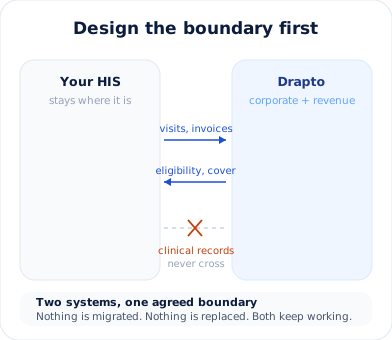
Every enterprise rollout needs an explicit answer to what flows in, who owns it, how it is mapped and which credentials never leave your control.
Email, portal download, or NHCX bundle. However they do it today, unchanged.
claims@yourhospital.drapto.in — set a forwarding rule once, or forward manually. Both work.
Reconciled line by line, predictable separated from unexplained, on your worklist before anyone opens a portal.
Why not just log into the portals?
Four ways an advice can reach us
| Route | Setup | Works with | Effort per claim |
|---|---|---|---|
| Auto-forward rule | Once, in your mail client | Any payer that emails | None |
| Manual forward | None | Any payer that emails | One click |
| Upload — PDF or image | None | Portal downloads, scans, paper | Drag and drop |
| NHCX bundle | Your NHA onboarding | Payers live on NHCX | None |
The first two cover the majority of Indian payers today. The fourth grows as NHCX adoption does — and needs no change at your end when it happens.
What we do with what arrives
- Patient identifiers are stripped on ingestion, before anything is parsed or stored. Names, UHIDs and policy numbers do not enter the record.
- Data stays in India. Indian data centres, no cross-border transfer, aligned to DPDP obligations.
- We never hold a payer credential. Not for your portals, not for your mailbox — a forwarding rule sends us a copy, it does not give us access.
- You can stop it in one step. Delete the forwarding rule and the flow ends. No integration to unwind.
Corporate contracts, without changing your system.
We find the companies and run the outreach. Your existing software stays where it is.