

Ayushman Bharat & CGHS
Hospital revenue integrity in Delhi NCR.
The highest concentration of CGHS beneficiaries in the country, alongside dense corporate cover and private pay.
Cities in Delhi NCR
Reading
How the scheme actually works here
The highest concentration of CGHS beneficiaries in the country sits alongside PM-JAY and dense private cover. CGHS pays accredited and non-accredited hospitals at different rates, which turns accreditation into an arithmetic question rather than an aspiration.
The payer mix in Delhi NCR
Gurugram and Noida are dominated by corporate group cover with high sums insured. Central Delhi carries CGHS and referral inflow from several states.
Where hospitals here lose money
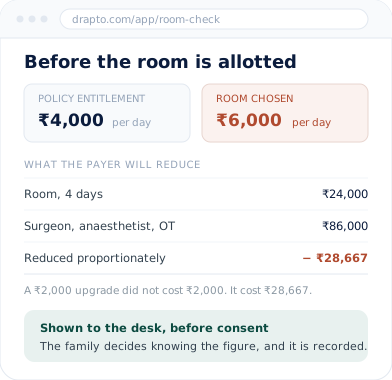
High sums insured mean high entitlements, which makes an upgrade look affordable to the family and to the counter. The ratio applies regardless.
Whether accreditation pays depends on your actual CGHS volume multiplied by the rate uplift, against the cost and the ongoing documentation burden. Do the calculation with your own case mix.
NCR's referral inflow produces out-of-hours admissions, and the notification clock starts at admission rather than when the TPA desk opens.
Check this week
Model a room upgrade on your three most common policies before anyone is admitted this week. If the counter cannot produce the deduction figure in under a minute, it is not being modelled at all.
What does not change at the state border
Room-rent proportionate deduction, pre-authorisation notification clocks, tariff drift against contract, and package-with-component billing work identically in Delhi NCR and everywhere else in India. They vary by contract, not by geography. What the state changes is the scheme layer sitting on top — which cases are viable, and what evidence the payer expects.
Worked through in detail: the nine ways an Indian payer reduces a claim, how scheme claims differ from private ones, and the ₹8,000 upgrade that costs ₹43,000.
Cities we cover in Delhi NCR
Questions from Delhi NCR
Does Drapto work with Ayushman Bharat & CGHS in Delhi NCR?
Yes. Package rates are held per scheme, so a case can be checked for viability before admission rather than at billing. The highest concentration of CGHS beneficiaries in the country sits alongside PM-JAY and dense private cover.
What do hospitals in Delhi NCR lose the most money to?
Proportionate deduction on planned upgrades. High sums insured mean high entitlements, which makes an upgrade look affordable to the family and to the counter. The ratio applies regardless.
Do the payer rules change between states?
The scheme layer does — package lists, empanelment and eligibility are state-specific. The mechanics underneath do not. Room-rent proportionate deduction, notification clocks and tariff drift work identically everywhere in India; they vary by contract, not by geography.
Is Drapto available across Delhi NCR?
Yes, anywhere in the state. Deployment is remote and takes one to five weeks depending on size, with your payer tariffs loaded before go-live rather than after.
What does the free audit involve?
Twenty claims you have already settled. We show what was disallowed, how much was predictable, and how much the payer never explained. About an hour of your team's time, and you keep the findings whatever you decide.
Read next
The scheme changes at the state border. The payer mechanics do not — room caps, notification clocks and tariff drift work the same way in Delhi NCR as everywhere else.
Every way an Indian payer reduces a claim →
Other states
Read next
What is not on this page. We do not publish hospital directories, rank hospitals, or list which facilities sit on any insurer’s or scheme’s panel. Empanelment is product-specific and changes constantly — a stale list published by a third party sends a family to a hospital believing they are covered when they are not.
Your Insurance Ombudsman
For repudiated claims in Delhi NcrA repudiated cashless claim in Delhi Ncr is generally heard by the Delhi office, which broadly covers Delhi; Haryana (some NCR districts). Filing costs nothing and needs no lawyer, but there is a one-year clock from the insurer’s final reply.
Jurisdiction is defined by district in several states. Confirm yours against the Council for Insurance Ombudsmen’s list before filing.
The scheme you actually bill
Delhi NCR| State scheme | Varies by which side of the border you are on |
| Alongside | Ayushman Bharat PM-JAY, private insurers and TPAs |
| Why it matters here | Delhi, Haryana and Uttar Pradesh have implemented differently. A hospital taking NCR patients deals with more than one arrangement. |
A hospital in Delhi Ncr prices against a different package list from one in the next state. Tariffs are held per payer and per contract in Drapto, so a claim is never priced under the wrong one.
Verify before you rely on this. State schemes are renamed, merged and revised with budgets and governments. This is a starting point for a conversation, not a compliance reference — check the current position with the state health agency.
See it on your own claims.
The payer mix is local. The mechanism is not — and it is the mechanism we show you.