

Maharashtra · MJPJAY / Ayushman Bharat
Revenue integrity for hospitals in Mumbai.
Highest private-pay share in the country alongside dense corporate cover.
What employer cover does to a deduction
Highest private-pay share in the country alongside dense corporate cover.
Where corporate group policies dominate, the terms are not negotiated by the patient and are frequently unknown to them. An employee admitted on a group policy usually cannot tell you their room entitlement, their co-pay, or whether their grade carries a sub-limit — because they never chose any of it.
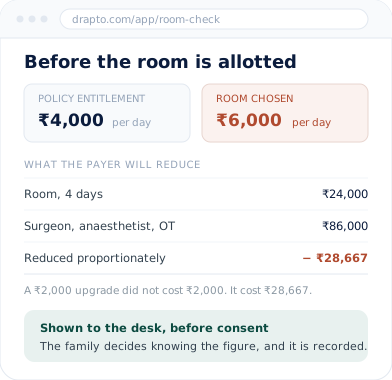
That has a specific operational consequence. The room-rent entitlement question, which decides the single largest deduction in Indian health insurance, cannot be answered at the desk by asking the patient. It has to come from the policy, and the policy sits with an employer or a TPA. A hospital that waits until discharge to find out has already allotted the room.
Group policies also carry their own approval chains. A pre-authorisation that would clear in an hour on a retail policy can sit waiting on an employer-side confirmation, and the clock does not stop while it waits.
The deduction that tends to bite here
Room-rent caps against high sums insured; upgrades are routine and proportionate deduction is the dominant leak.
Whichever mechanism dominates locally, the arithmetic is the part worth internalising. A room-rent breach is the clearest example: it does not cost the rate difference, it reduces surgeon fees, theatre, nursing and investigations in the same proportion. An eligible rate of ₹5,000 against a room at ₹10,000 halves the associated charges on the whole bill. That is why entitlement is an admission-desk question rather than a billing question.
What to check before admission in Mumbai
- The room entitlement on the actual policy, not the patient's recollection of it.
- Whether the grade or band carries a sub-limit the employee is unaware of.
- Co-pay, which on group policies is often applied to the full bill rather than a part.
- Who authorises on the employer side, and how long that has taken before.
- Whether the policy is a top-up sitting above a base cover, which changes the order of settlement.
The three deductions that survive discharge
Wherever a hospital sits, most of what is written off falls into three groups, and they behave completely differently once the patient has gone home.
Room entitlement, eligibility, pre-authorisation. Cheap to fix before the patient is admitted and effectively unrecoverable afterwards. This is where the money is.
Medical necessity, documentation, package selection. Recoverable if the file supports it, which depends entirely on what was written at the time.
Co-pay, sub-limits, non-medical items. Not errors and not appealable. Worth knowing precisely so nobody spends a week chasing them.
The first group is the one that rewards attention, because it is the only group where the outcome is still open while the patient is in front of you.
The audit, on your own claims
Twenty claims your hospital in Mumbai has already settled, showing what was disallowed, how much was predictable and how much the payer never explained. About an hour of your team’s time.
Reading
What is not on this page. We do not publish hospital directories, rank hospitals, or list which facilities sit on any insurer’s or scheme’s panel. Empanelment is product-specific and changes constantly — a stale list published by a third party sends a family to a hospital believing they are covered when they are not.
Your Insurance Ombudsman
For repudiated claims in MumbaiA repudiated cashless claim in Mumbai is generally heard by the Mumbai office, which broadly covers Goa; Mumbai Metropolitan Region. Filing costs nothing and needs no lawyer, but there is a one-year clock from the insurer’s final reply.
Jurisdiction is defined by district in several states. Confirm yours against the Council for Insurance Ombudsmen’s list before filing.
The scheme you actually bill
Maharashtra| State scheme | Mahatma Jyotirao Phule Jan Arogya Yojana (MJPJAY) |
| Alongside | Ayushman Bharat PM-JAY, private insurers and TPAs |
| Why it matters here | Runs converged with PM-JAY. Package rates and the empanelment route are state-defined. |
A hospital in Mumbai prices against a different package list from one in the next state. Tariffs are held per payer and per contract in Drapto, so a claim is never priced under the wrong one.
Verify before you rely on this. State schemes are renamed, merged and revised with budgets and governments. This is a starting point for a conversation, not a compliance reference — check the current position with the state health agency.
See it on your own claims.
The payer mix is local. The mechanism is not — and it is the mechanism we show you.