

A booking page better than the ones clinics pay for.
Most clinic booking software is a form that emails the front desk. This fills its own cancellations, recognises people who have been before, books a whole family on one number, and carries your colour rather than ours.
About ten minutes to set up. Patients never pay us, and we never take a share of your consultation fee.
The screen
62
8
23
11
8Flagged likely no-show, slot still heldoffer to waitlist
5Cancelled inside 2h, slot empty23 waiting
14Follow-up advised, never bookedrecall
6Family booking, one member unconfirmedconfirm
11Waitlist patient seated in a freed slotfilled
Free forever, for every clinic. no commission on an in-person consultation, no paid ranking, no charge per booking.
The one thing that is not free
Video consultations carry 12%.
In person, the patient pays you at the desk and we handle none of it — there is nothing for us to take a share of. A video consultation is different: we provide the room, the connection and the payment rail.
The 12% includes the payment gateway’s own cut rather than adding to it, so the number you receive is one figure you can predict. Money is held fourteen days before release — that window is what lets a patient be refunded without taking it back from a doctor already paid. GST applies to the platform fee, not to the consultation; your accountant will tell you how that sits with your registration.
The arithmetic nobody does
What an empty slot costs, over a month.
Not a projection. Four figures a clinic already knows, multiplied.
Illustrative figures. Put your own four in and the answer changes. The mechanism does not: a slot that goes unused is not recoverable, and a reminder that arrives costs nothing. This is why confirmations are free permanently.
Where the money goes
Nine hundred rupees, three ways.
A patient books a consultation. What reaches the clinic depends entirely on who owned the page they booked through.
The waitlist
A cancellation at four o’clock is a slot that dies at four o’clock.
Somebody rings to cancel tomorrow’s eleven o’clock. In most clinics that slot is now empty, and it stays empty, because filling it would mean someone working through a list and ringing people who are at work themselves.
So nobody does it, and the clinic quietly runs at less than capacity while patients who wanted an earlier appointment sit waiting for one.
The cancellation is noted. The slot shows as free on a screen nobody is watching. It passes unfilled, and the clinic learns nothing from it.
The freed slot is offered to the waitlist automatically. The first person to confirm takes it, in one tap, from wherever they are.
Capacity is the one thing a clinic cannot sell twice. An unpaid balance can be chased next month; an empty eleven o’clock is simply gone.
The offer is time-boxed, and it says so. A waitlist offer that sits unanswered has to expire and move on, or the slot is held hostage by somebody who has stopped reading their messages — which is the original problem with extra steps.
Returning patients
Nobody wants to type their own name for the twelfth time.
The patient booking with you today has probably booked before. Asking them to re-enter their name, age and phone number is not a security measure — it is a form that was never told they already exist. Every field is a place to drop out, and the people who drop out are disproportionately the ones booking on a phone in a hurry.
A returning patient is recognised from the number they are booking with, picks a doctor and a slot, and is done. Their record is already there, and so is their history with you.
Fewer fields, fewer drop-offs
The shortest path is the one for people who have already chosen you. Those are the bookings a clinic can least afford to lose.
Fewer duplicate records
A patient who re-registers becomes a second file, and their history splits in two. That is a clinical problem before it is an administrative one.
The front desk sees one person
Not "Sunita Devi" and "S. Devi" and a mobile number with a stray digit, arriving as three different patients.
Family booking
In India, one number books for the whole household.
A daughter books for her father. A husband books for his wife and both children. Software that assumes one phone number equals one patient forces all of that through a single identity, and the result is a record with four people’s history in it.
One number, several patients, each with their own record. The person booking picks who the appointment is for, and the history goes to the right file.
Each family member’s record stays their own. Sharing a booking number is not the same as sharing a medical history, and an adult who was once booked by a relative can hold their own record independently. Convenience at the booking step should not quietly become a disclosure at the clinical one.
Follow-ups
“Come back in seven days” is not an appointment.
It is an intention, spoken in a room the patient is about to leave, and it decays on the walk to the car park. The follow-up a doctor asks for is the single most commonly lost appointment in any clinic, and nothing in a paper system carries it forward.
Here the follow-up is created as a real appointment, attached to the prescription the patient is holding, already pointed at the right clinic and the right doctor. It appears in the calendar as a booking rather than as a note somebody has to act on.
No-shows
A predicted no-show is a property of a slot, not a verdict on a person.
Clinics lose real money to appointments nobody attends, and the pattern is usually legible: long lead times, certain sessions, certain days. Knowing which slots are at risk lets a clinic decide about reminders, or about overbooking a particular session, with a figure instead of a feeling.
What that must never become is a score that decides who is allowed to book. So it does not surface as a label on a patient, it is not shown to the person taking the booking as a reason to refuse anybody, and no part of the booking flow is gated on it.
What it is for
Deciding where a reminder is worth sending, and whether a particular session can safely carry an extra booking.
What it is not for
Refusing an appointment, demanding a deposit, or ranking patients. A model that gates access to care on a probability is a discrimination engine, whatever it is called.
Overbook against a measured rate or not at all. Overbooking against an impression produces a waiting room that punishes the patients who did turn up, which costs more goodwill than the empty slot was worth.
Your colour, not ours
The page a patient lands on should look like your clinic, not like a vendor.
A patient searching your name and landing on a page carrying somebody else’s branding has been handed off, and it reads that way. Your booking page takes your colour, so the page that converts looks like the board outside your door.
Whatever colour you pick, the text on it is contrast-checked before the page goes live. A brand colour that renders your appointment times unreadable on a phone in daylight is not a branding feature, it is a lost booking — so the check is not optional and the palette adjusts rather than the readability.
What stays ours. The layout, the flow and the accessibility behaviour. You get the colour and the identity; you do not get to remove the skip link, the contrast floor or the plain-language dosage text, because those are the parts that make the page work for the patient who needs them most.
What it will not do
The limits, stated where you can find them.
We will never take a share of an in-person consultation your patient pays you for directly. Patients pay you. There is no per-booking fee, no commission and no payment-gateway margin on a consultation the patient pays you at the clinic.
We will never sell placement. /find is a search, not a ranking. No clinic
can pay to appear higher, which is also why it will never send you patients you had not already
earned.
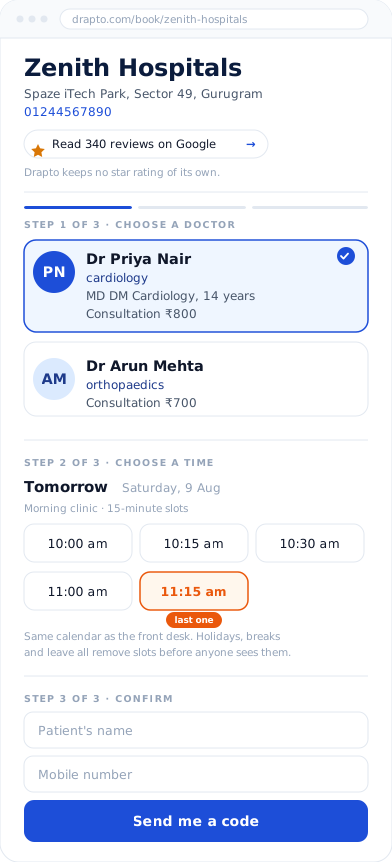
We keep no star rating of our own. Your reviews stay on Google, where patients already trust them and where we cannot sell your position in them.
This is not a marketplace and not a teleconsultation service. It is the booking page for your clinic, at your address, carrying your name.
What a booking actually costs you
The three days around an appointment
Free, and what that means exactly
What free usually means
- Fourteen days, then a card
- Capped at 50 appointments
- Their branding on your page
- Moved behind the paywall next year
What it means here
- No clock and no card
- Unlimited patients and appointments
- Your colour and your name
- Never moved behind the paywall
Six places to put the link
| Where | Why it works |
|---|---|
| Google Business Profile | Where most people already find you |
| A QR on the reception desk | Books the next visit before they leave |
| Your email signature | Every message becomes a booking link |
| The prescription pad | Printed on the follow-up they were told to make |
What runs without being asked
Improved most weeksA cancellation is offered to the next person in order, with a window, until somebody takes it.
Raised when the prescription is written, chased twice, then it stops. It does not nag.
An abnormal value escalates after thirty minutes if nobody named has acknowledged it.
Twenty-four rules, scored before submission and sorted by exposure rather than raw risk.
Ctrl-K from any screen. These are database queries, so they work offline and cost nothing.
Ask in your own words. Bring your own Anthropic or OpenAI key, or run Ollama on your hardware and nothing leaves the building.
We are deliberate about which is which. Most of what runs here is rules, not a model — because a rule is auditable, works when the connection drops, and cannot invent a figure. We build and improve both every week, and we will always tell you which one answered you.
Prescriptions a patient can actually read
Four live, four in clinical review| Language | Status | |
|---|---|---|
| English | Live | Reviewed |
| Hindi — हिन्दी | Live | Reviewed |
| Marathi — मराठी | Live | Reviewed |
| Tamil — தமிழ் | Live | Reviewed |
| Bengali — বাংলা | In review | Awaiting a clinician |
| Telugu — తెలుగు | In review | Awaiting a clinician |
| Gujarati — ગુજરાતી | In review | Awaiting a clinician |
| Kannada — ಕನ್ನಡ | In review | Awaiting a clinician |
We do not machine-translate a dose. A model asked to render “one tablet twice daily after food” will usually be right, and usually is not a standard that applies to a dose instruction — a dropped negation reaches a patient with no clinician present to catch it. So every phrase is a fixed table, translated once, and it is not offered to a clinic until a doctor who speaks that language has read all twenty-three. Anything outside the table stays in English: a phrase somebody must ask about is far safer than a confident mistranslation they act on.
Corporate contracts, without changing your system.
We find the companies and run the outreach. Your existing software stays where it is.