

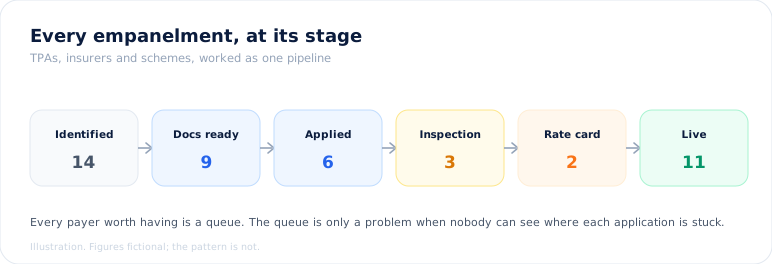
Empanelled with nine payers.
Nine different sets of rules.
Every insurer and TPA you are empanelled with has its own tariff, its own room-rent rule and its own idea of what needs pre-authorisation. Most hospitals hold that in one person’s head, and when that person is on leave the deductions start.
Every tariff, per payer
Rate cards pasted from a sheet, held per contract. A procedure priced under the wrong payer’s tariff is a deduction nobody argues with because nobody notices.
Room caps, modelled before admission
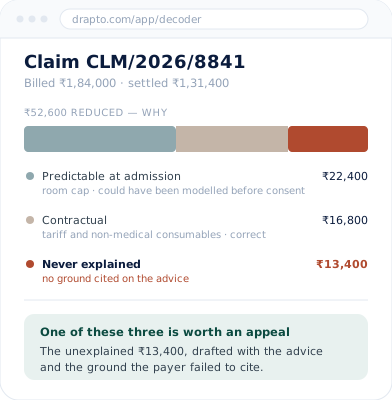
A category above the cap does not reduce the room charge. It proportionately reduces everything — surgery, consumables, the lot. That is arithmetic, and it can be shown at the desk.
The pre-auth clock
Drafted, tracked, and escalated when a payer has not responded. A pre-auth that expired is a cashless case that became a cash case at discharge.
What we do not claim
Drapto is not an insurance intermediary, is not registered with IRDAI and does not represent you in a dispute. We do not transmit to NHCX on your behalf.
One price, wrong, all year
A tariff mismatch does not stay small.
A single procedure priced against last year’s contract, repeated at volume, for twelve months.
Illustrative figures. The point is the multiplication: a deduction small enough to ignore on one claim is not small across a contract year, and nine payers means nine contracts drifting independently.
The screen
23
5
3
19
3Billing against a superseded tariffreload
5Renewal inside 60 days, pack not startedbegin
4Rate list signed, never loadedload
2NABH certificate expiringrenew
19Complete, nothing outstandingno action
Empanelment is paperwork with a clock on it. This is the paperwork, and the clock.
What runs without being asked
Improved most weeksA cancellation is offered to the next person in order, with a window, until somebody takes it.
Raised when the prescription is written, chased twice, then it stops. It does not nag.
An abnormal value escalates after thirty minutes if nobody named has acknowledged it.
Twenty-four rules, scored before submission and sorted by exposure rather than raw risk.
Ctrl-K from any screen. These are database queries, so they work offline and cost nothing.
Ask in your own words. Bring your own Anthropic or OpenAI key, or run Ollama on your hardware and nothing leaves the building.
We are deliberate about which is which. Most of what runs here is rules, not a model — because a rule is auditable, works when the connection drops, and cannot invent a figure. We build and improve both every week, and we will always tell you which one answered you.
Questions we are actually asked
No. Drapto builds and validates NHCX-ready FHIR R4 bundles. It does not claim to transmit them for you, and we are not an insurance intermediary.
A room category above the cap does not just reduce the room charge. It proportionately reduces surgery, consumables and investigations too. That is arithmetic, and it can be shown at the desk before admission.
Nine payers. Nine sets of rules.
Most hospitals hold that in one person’s head, and the deductions start when that person is on leave.
Start with the half that pays for itself.
Corporate contracts first. The clinical side is an addition, never a precondition.