

Drapto finds the money Indian hospitals write off as “policy terms.”
Mechanisms that are built and running — not recovery percentages we have no customers to prove yet.
The screen
₹18,40,000
142
₹2,70,000
38
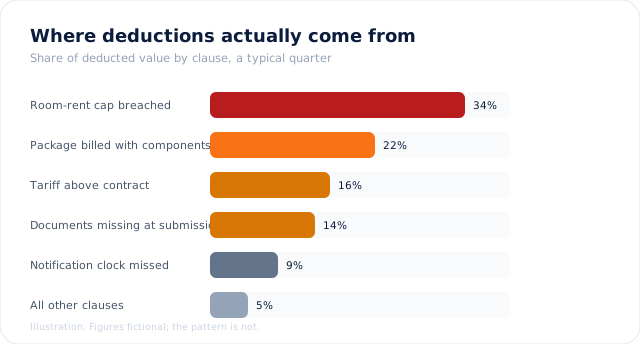
82%Room cap breached, no consent on file₹4,28,570
64%Package billed with components₹1,92,000
31%Tariff above the contracted rate₹2,40,000
28%Notification clock at 19h of 24h₹1,15,000
12%Unspecified ICD-10 across 9 claims₹4,05,000
Risk multiplied by amount. The claim most likely to be cut is rarely the claim with the most money in it.
Revenue integrity
Not a claim about recovery rates — we have no customer outcomes to quote yet, and we will not invent them. What follows is a list of mechanisms that are built and running, each of which catches money that is currently leaving quietly.
The one nobody models
The room upgrade that costs five times what it looks like.
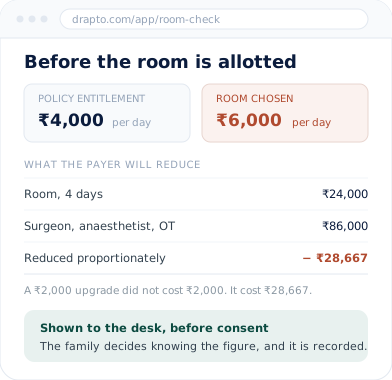
A patient asks for a better room. The rate difference is ₹2,000 a night. Over four nights that is ₹8,000, and the counter says yes.
It is not ₹8,000. Breach the room-rent cap and most Indian policies apply a proportionate deduction to every associated charge — surgeon fees, OT, investigations, consumables — cut in the same ratio as the room breach.
- Drapto models the full proportionate deduction, not just the rate delta
- It runs at admission, while the room can still be changed — not on the settlement advice three weeks later
- It recommends the best room the patient can have at zero cost before any upgrade is offered
- It records informed consent against a named user — the document that settles the argument at the discharge counter
The difference is what the hospital absorbs, and what the billing manager finds out about at settlement.
The room difference is ₹8,000. The deduction is ₹43,000 — because the ratio is applied to every associated head, not to the room.
The ones nobody goes looking for.
Every item below is a mechanism that exists in the product today.
Coding without a coder
An ICD-10 engine built for Indian clinical shorthand. “Sugar,” “loose motions,” “koch’s,” “daad,” “kamzori” all resolve correctly. Dengue, typhoid, malaria, TB and scrub typhus are first-class, not exotic imports.
Deterministic, offline, about a millisecond. It cannot invent a code that does not exist.
It learns your shorthand
Code a phrase twice and it is suggested instantly from then on. Unspecified catch-all codes are flagged — payable, but the ones TPAs query.
Coverage dashboard, accept-rate by confidence, and a report of the phrases it keeps getting wrong.
Dictation arrives already coded
The ambient scribe extracts the diagnosis, attaches the ICD-10 code, and stamps provenance on acceptance. Hindi, Marathi and Tamil supported.
The consultation and the coding stop being two separate jobs.
Know a claim will be rejected before you send it
24 rules across documentation, authorisation, identity, timing, money and payer history — weighted probabilistically, so scores stay separable instead of every messy claim pinning at 100.
Unknown facts never fire a rule. No tariff on file means silence, not a false accusation.
Fix once, not a hundred times
The worklist sorts by exposure — risk multiplied by amount — not raw risk. Claims sharing a cause are aggregated so one correction clears the batch.
A 12% risk on ₹4L outranks an 80% risk on ₹6,000.
Pre-authorisation drafted from the encounter
Diagnosis, codes, doctor and proposed treatment pulled from what is already recorded. Incomplete sends are blocked with the missing item named.
The notification clock — 24h emergency, 72h planned — is tracked. It decides whether an admission stays cashless.
Find out why the payer short-paid
The settlement advice is parsed line by line, and the shortfall split into predicted-and-accepted versus unexplained. The second list is what you query.
Copay is excluded from “lost” — that money is collectable, not gone.
Discharge summaries assembled from the stay
Hospital course composed from the treating doctor’s own dated notes, never a generated narrative. Abnormal results named, normal panels collapsed, discharge meds limited to what is still running.
Quality-scored, because a summary that says nothing gets queried as often as a missing one.
Payer contracts and tariffs
Rate cards imported by pasting straight from the spreadsheet. Catches billing above agreed rates, packages billed alongside their components, and unpriced codes.
Ward rates suggested from what you have already been billing.
Software that learns your payers
Recurring denial reasons are mined into proposed rules with the evidence attached. Proposed, never auto-applied — a human accepts each one.
Risk weights calibrate from your own settled claims, shrinking from assumption toward measurement.
ABDM and NHCX
ABHA linking, FHIR R4 records and consent flows. NHCX-ready claim bundles built and validated, with a readiness check naming exactly which of six things blocks your onboarding.
We generate and validate the payload. Transmission runs through your NHA onboarding.
Per-branch leakage comparison
For groups: which of your six clinics is losing the most, and why. One payer contract set applied across every branch, one consolidated view.
A question only a group owner has, and one nobody currently answers.
What we are not claiming
A hospital that catches one exaggeration stops trusting all of it. So, plainly:
The other side of the same claim
When a claim is rejected, the patient gets a letter too. Our claim-help pages explain the fifteen grounds in plain language and the official escalation path — useful to hand a family at the discharge counter.
What clinicians tell us about the documentation burden shaped a good deal of how the coding and discharge-summary layers work.
See it against your own numbers
Bring one month of settled claims and we will show you what the engine would have flagged before they went out.
Deployments
Where this has been deployed
Anonymised by agreement — no names, no logos. What is shown is the mechanism that was put in place.
- Room entitlement checked against policy at admission
- Proportionate deduction modelled before the room is allotted
- Consent recorded against a named user
- Rate cards imported by pasting from the spreadsheet
- Billing above agreed rates flagged before send
- Packages billed with components caught
- Advice parsed line by line
- Shortfall split into predicted versus unexplained
- Copay separated from lost revenue
Built to standards, not to a demo
What we will never do
Things we have promised not to do
- Take a cut of a consultation fee
- Charge per appointment
- Sell a position in the directory
- Host star ratings
- Move a free thing behind the paywall
How we are actually paid
- Hospitals, for revenue integrity
- Companies, for corporate health
- Labs and pharmacies, for their modules
- Implementation, because it is somebody’s week
- Nothing from a patient, ever
One room or two hundred beds.
Start with the half that pays for itself.
What runs without being asked
Improved most weeksA cancellation is offered to the next person in order, with a window, until somebody takes it.
Raised when the prescription is written, chased twice, then it stops. It does not nag.
An abnormal value escalates after thirty minutes if nobody named has acknowledged it.
Twenty-four rules, scored before submission and sorted by exposure rather than raw risk.
Ctrl-K from any screen. These are database queries, so they work offline and cost nothing.
Ask in your own words. Bring your own Anthropic or OpenAI key, or run Ollama on your hardware and nothing leaves the building.
We are deliberate about which is which. Most of what runs here is rules, not a model — because a rule is auditable, works when the connection drops, and cannot invent a figure. We build and improve both every week, and we will always tell you which one answered you.
Start with the half that pays for itself.
Corporate contracts first. The clinical side is an addition, never a precondition.