

For Indian hospital and clinic groups
Six branches, or one business
with six addresses?
A group is not buying six copies of the same software. It is buying the layer above the locations — one negotiated contract set, and a straight answer to which branch is bleeding.
6
₹38.2L
Branch 4
1
₹11.4LBranch 4 — tariff two revisions behindhighest
₹8.1LBranch 2 — room caps not modelled2nd
₹6.7LBranch 6 — pre-auth clocks missed3rd
₹5.9LBranch 1 — documentation queries4th
₹3.2LBranch 3 — best performingbaseline
The layer above the locations.
Leakage, ward and the companies you serve — across every branch.
 ₹30.98L foundSigned and frozen by the CFODeductions going cold
 49 companies in play2 findings not followed upInvoiced and unpaidWhat needs doing
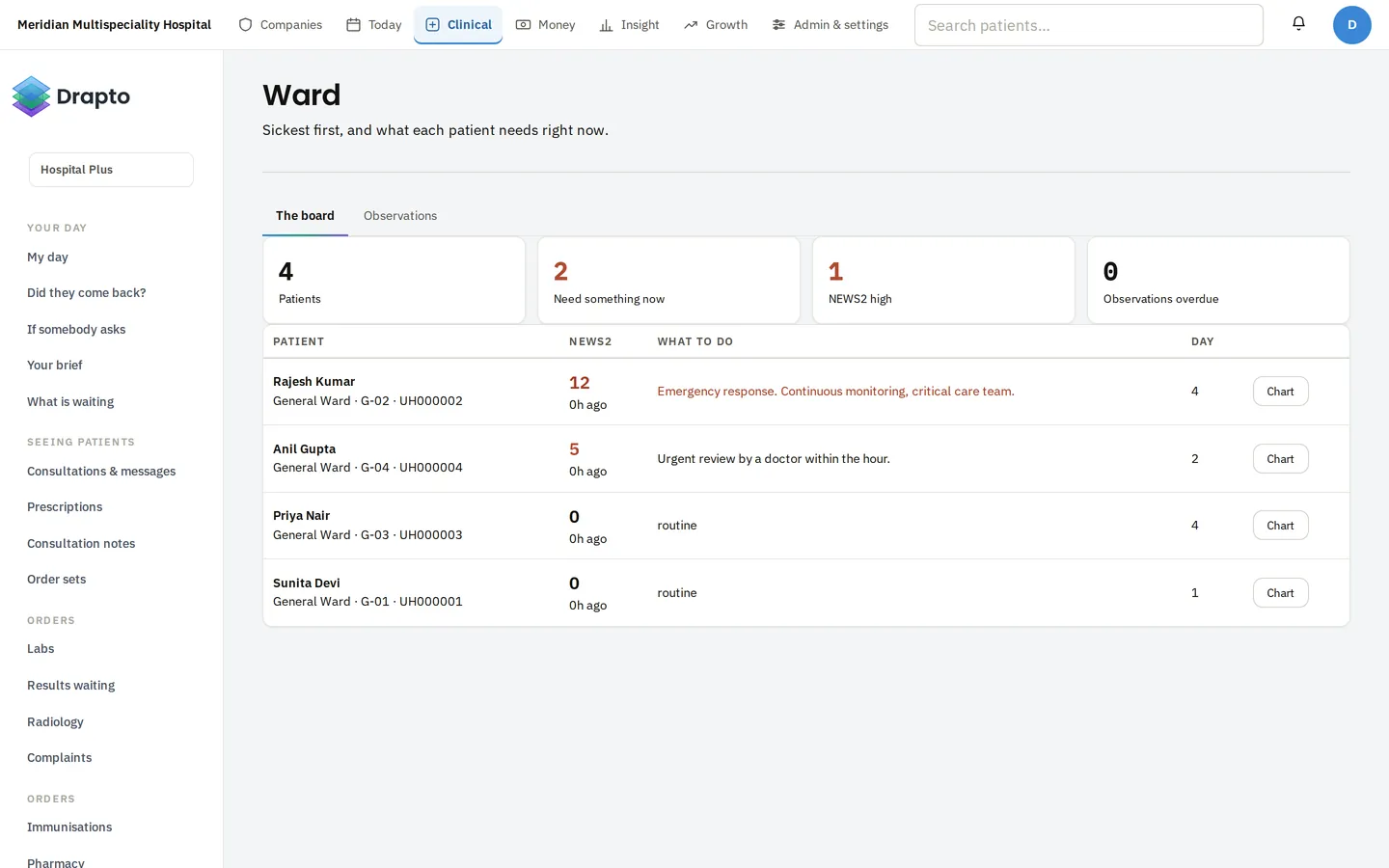
Demo workspace · sample names and figures. Tap any screen to enlarge.
The question only you have
Which of my six branches
is losing the most, and why?
A single-site hospital never asks this, and no single-site system answers it. It is also the question that decides where you spend your attention this quarter — and answering it requires every branch to classify deductions the same way. If branch three calls something a tariff mismatch and branch five calls the same thing a documentation issue, the comparison is noise. Shared taxonomy comes before shared reporting.
A group negotiating with a payer once and applying it across six branches has leverage. Six branches negotiating separately have none, and end up on six rate cards that drift further apart at every revision.
Absolute leakage always makes the biggest branch look worst. Per bed-day is the comparison that tells you something you can act on.
Duplicate records inflate your patient count, break recall lists and make campaigns target people who already came back. A single ABHA linkage per patient solves most of it — before the duplicates accumulate.
Contracts, tariffs, roles and reporting centrally. Clinical and billing operations locally. A branch manager should not need permission to run their day, and should be unable to alter a payer contract.
What breaks as you grow
It is usually branch four or five.
| At two branches | At six |
|---|---|
| The owner sees every claim | Nobody sees every claim |
| One rate card, informally shared | Six rate cards, silently diverging |
| A patient is at one branch | A patient is at whichever is nearest today |
| Roles are informal | Roles need to be actual permissions |
| Consolidation by memory | Consolidation requires a system |
The transition arrives as a general sense that things are slipping rather than as a specific failure. That is what makes it hard to act on in time.
What a group should measure
Four numbers, monthly.
Not absolute leakage. Otherwise the biggest branch always looks like the problem and the small underperformer stays invisible.
Same payer, same procedure, best branch against worst. The gap is what fragmented negotiation has cost you.
Across the group, not per branch. Per branch it always looks fine.
Per branch, in days. This is where tariff drift starts, and it is the earliest warning you get.
Deployments
Groups running this today
Anonymised by agreement — no names, no logos. What is shown is the mechanism that was put in place.
- One payer contract set applied to every branch
- Per-branch leakage comparison
- Cross-branch records with a single ABHA linkage
- Sessions tracked against the package sold
- Lapsed packages surfaced for recall
- Vernacular prescriptions in Tamil
- Branch-level comparison on one screen
- One consolidated invoice
- Central roles and admin
Built to standards, not to a demo