

Four hundred staff.
One invoice. Nobody chasing a spreadsheet.
Sold to you, not to a hospital that then adds a margin. One employer with four hundred staff is worth more to us than four hundred patients, because you do not leave.
Corporate health
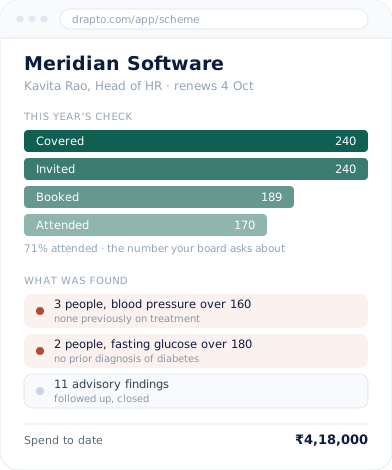
Sold to the company, never to the clinic. One employer with four hundred staff is worth more than four hundred patients, because they do not leave.
Core
Up to 250 employees
₹3,60,000/year
₹1,440 per employee
- HR portal on a link — no account, no login for them to forget
- Eligibility checked at the desk in seconds
- Health-check campaigns with an invite per employee
- Spend, utilisation and per-person cost, live
- Aggregate workforce health — counts, never names
HR sees who attended and what it cost. Never why anybody attended — that is between them and the doctor, and under DPDP it has to be.
Business
Up to 1,000 employees
₹10,80,000/year
₹1,080 per employee
- Everything in Core
- Health packages, approvals, corporate billing
- Multi-location, department reports, manager dashboards
- Statutory register — Factories Act periodic examination, produced on inspection
- Findings followed through, not left in a spreadsheet
The statutory register is the reason this does not get switched. A gap in it is not a preference — it is the finding an inspector writes down.
Enterprise
Unlimited employees
₹24,00,000/year
By headcount and locations
- SSO, custom integrations, API access
- Occupational health across sites
- Named success manager and SLA
- Onsite camps, coordinated end to end
Priced against what a company already spends on a scheme it cannot measure.
All figures in ₹ INR, all taxes included. Annual billed as ten months. Multi-location groups pay a declining per-location rate plus a platform fee. Prices for an existing customer do not rise at renewal.
Before you put anything in, read how to take it out.
Your records export in open formats, on demand, without asking us and without a fee. We would rather you check that now than discover it matters later — a company that makes leaving hard is telling you it expects you to want to.
The comparison
Per employee, per year, against one admission.
A corporate health scheme is priced per head. What it is measured against is usually a single hospital admission that did not happen.
This is the argument for corporate health, and it is also why we will not quote you a saving. Whether a scheme prevents an admission depends on whether people use it — which depends on whether they believe you cannot see why they went.
What runs without being asked
Improved most weeksA cancellation is offered to the next person in order, with a window, until somebody takes it.
Raised when the prescription is written, chased twice, then it stops. It does not nag.
An abnormal value escalates after thirty minutes if nobody named has acknowledged it.
Twenty-four rules, scored before submission and sorted by exposure rather than raw risk.
Ctrl-K from any screen. These are database queries, so they work offline and cost nothing.
Ask in your own words. Bring your own Anthropic or OpenAI key, or run Ollama on your hardware and nothing leaves the building.
We are deliberate about which is which. Most of what runs here is rules, not a model — because a rule is auditable, works when the connection drops, and cannot invent a figure. We build and improve both every week, and we will always tell you which one answered you.
Questions we are actually asked
₹3,60,000 a year for up to 250 employees, ₹10,80,000 for up to 1,000, and ₹20L–₹60L for enterprise by headcount and locations. All taxes included.
No. HR sees who attended and what it cost, never why. Findings are aggregated and suppressed below five people, because in a team of three an aggregate identifies somebody.
Yes, on the Business tier and above, produced from the examinations you already run rather than assembled before an inspection.
₹1,080 per employee, per year.
At a thousand staff. Less than one health check, for eligibility, campaigns and the statutory register.
Priced on what we bring you.
Corporate contracts need no migration and no IT committee. The clinical side waits until you want it.