

Your HMS records what happened.
It does not change what happens.
This is the largest category and the software most hospitals already have. It is mature and it works. The gap is narrow, specific, and expensive.
Where the two overlap, and where they do not
| Capability | A typical HMS | Drapto |
|---|---|---|
| Appointments, records, prescriptions | Yes | Yes, free |
| Billing and collections | Yes | Yes |
| Raises the claim | Yes | Yes |
| Reports that a claim was reduced | Yes | Yes |
| Warns at admission that the room breaches the cap | No | Yes |
| Models the proportionate deduction before it happens | No | Yes |
| Scores the claim against 24 rejection rules | No | Yes |
| Parses the settlement advice and splits CO from PR | No | Yes |
| Tells you which deduction was predictable | No | Yes |
The moment the two diverge
Keep your HMS if
- Your staff know it and it is not the problem
- You have deep configuration you would lose
- Your leakage is genuinely small
The gap costs you if
- You cannot itemise last month’s deductions
- Room-category upgrades happen and nobody models them
- Settlement advices arrive and nobody reads them line by line
This describes a category, not a named product. Individual vendors differ and change — check the one you are actually considering, and hold us to the same standard.
What runs without being asked
Improved most weeksA cancellation is offered to the next person in order, with a window, until somebody takes it.
Raised when the prescription is written, chased twice, then it stops. It does not nag.
An abnormal value escalates after thirty minutes if nobody named has acknowledged it.
Twenty-four rules, scored before submission and sorted by exposure rather than raw risk.
Ctrl-K from any screen. These are database queries, so they work offline and cost nothing.
Ask in your own words. Bring your own Anthropic or OpenAI key, or run Ollama on your hardware and nothing leaves the building.
We are deliberate about which is which. Most of what runs here is rules, not a model — because a rule is auditable, works when the connection drops, and cannot invent a figure. We build and improve both every week, and we will always tell you which one answered you.
Prescriptions a patient can actually read
Four live, four in clinical review| Language | Status | |
|---|---|---|
| English | Live | Reviewed |
| Hindi — हिन्दी | Live | Reviewed |
| Marathi — मराठी | Live | Reviewed |
| Tamil — தமிழ் | Live | Reviewed |
| Bengali — বাংলা | In review | Awaiting a clinician |
| Telugu — తెలుగు | In review | Awaiting a clinician |
| Gujarati — ગુજરાતી | In review | Awaiting a clinician |
| Kannada — ಕನ್ನಡ | In review | Awaiting a clinician |
We do not machine-translate a dose. A model asked to render “one tablet twice daily after food” will usually be right, and usually is not a standard that applies to a dose instruction — a dropped negation reaches a patient with no clinician present to catch it. So every phrase is a fixed table, translated once, and it is not offered to a clinic until a doctor who speaks that language has read all twenty-three. Anything outside the table stays in English: a phrase somebody must ask about is far safer than a confident mistranslation they act on.
Questions we are actually asked
It warns at admission that a room category breaches the payer cap, models the proportionate deduction before it happens, scores the claim against 24 rejection rules before submission, and parses the settlement advice line by line. An HMS records that a deduction happened.
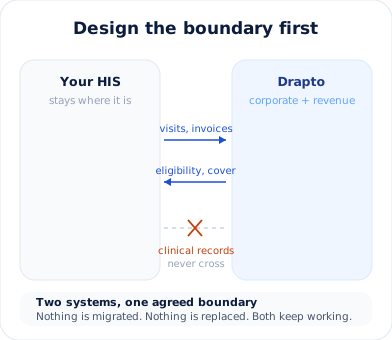
No. It can run alongside. If your staff know your current system and it is not the problem, keep it.
Your HMS records what happened.
It does not warn you at admission that the room breaches the cap, and by the time the settlement advice arrives the only option left is an appeal.
The honest version of the comparison.
We have written down what we will not claim, which is the part most comparisons leave out.