

Guides for doctors · referrals
What a referral letter has to contain, and why most get ignored.
A specialist reading your referral is behind, has a waiting room, and is deciding in about twenty seconds whether they can act on it or whether they will have to ring you. Almost everything that goes wrong with referrals is decided in those twenty seconds.
The failure is almost never the clinical content.
Doctors write good clinical summaries. What they leave out is the part that lets the other person do something: what specifically is being asked, how soon, and whether the patient can be contacted directly.
A referral that describes a patient beautifully and never states the question turns into a phone call, and the phone call is the thing everybody was trying to avoid.
“Kindly see and do the needful. 52M, hypertension, on treatment. Thanks.”
“Uncontrolled hypertension on three agents. Suspect secondary cause — would value your opinion on further workup. Within a week if possible.”
Same patient, same clinical facts. The second one names a question and a timeframe, so the specialist can triage it against everything else on their desk instead of parking it.
The structure
Six things, in this order.
Ordered by what the reader needs first, not by how a case is presented on a ward round. The specialist decides whether to accept before they read the history.
- The question you are askingOne sentence, and specific. “Would value your opinion on further workup” is a question. “Do the needful” is not — it transfers the whole problem, including deciding what the problem is.
- How soonA timeframe, not a colour or an exclamation mark. Within a week means the same thing to both of you; urgent means whatever the sender was feeling when they wrote it.
- Who you are and how to reach youName, clinic, and a number that gets answered. A referral that a specialist cannot reply to is a referral you will chase.
- AllergiesBefore medication, always. It is the one item where the cost of omitting it is not an inconvenience.
- Current medication, with dosesDoses matter more than names here. “On amlodipine” and “amlodipine 10mg OD” lead to different next steps.
- Relevant history — and what you have not sharedIf the patient asked you not to include something, say a section was withheld rather than leaving it blank. An empty history and a withheld one look identical, and the specialist rings you to find out which.
The one people skip. Number six. Withholding is a patient’s decision to make, but a silent omission puts the specialist in the position of not knowing whether they have the whole picture — which is exactly the uncertainty the referral was supposed to remove.
A worked example
The same referral, written to be acted on.
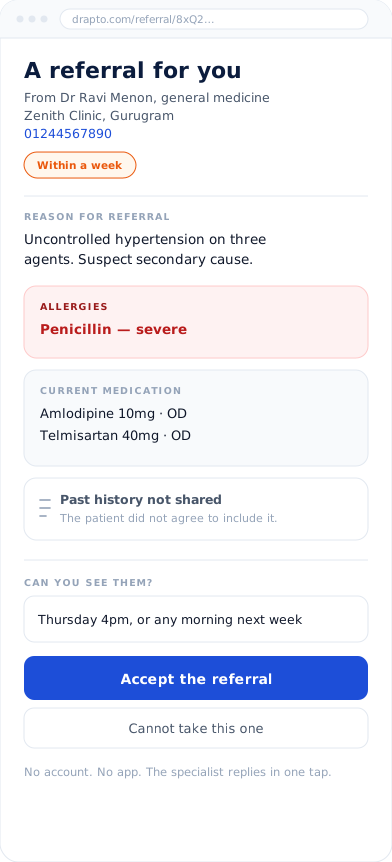
Names here are fictional. Everything else is the shape of a referral a specialist can answer without picking up a phone.
Referral
- From
- Dr Ravi Menon, general medicine · Zenith Clinic, Gurugram · 01244567890
- Question
- Uncontrolled hypertension on three agents. Suspect secondary cause — would value your opinion on further workup.
- Timeframe
- Within a week
- Allergies
- Penicillin — severe
- Current medication
- Amlodipine 10mg OD · Telmisartan 40mg OD
- History
- Past history not shared — the patient did not agree to include it.
It takes no longer to write than the version that gets a phone call. The difference is entirely in what is stated rather than assumed.
The part nobody instruments
You almost certainly do not know your own referral outcomes.
Most doctors cannot say what proportion of the referrals they sent last quarter were accepted, declined, or never answered at all. Not because they do not care, but because there is nowhere that information lands — the referral leaves on paper and the loop closes, if it closes, at the patient’s next visit.
That matters for two reasons. It means a specialist who has quietly stopped taking your referrals looks identical to one who is taking all of them. And it means a patient who never went looks identical to one who went and was fine.
What to track, if nothing else
Sent, accepted, declined, unanswered — against the patient it was about. Four states are enough to see a pattern.
What it changes
Who you refer to, how you word the ask, and which patients need a follow-up call rather than an assumption.
How Drapto does it
A link the specialist answers in one tap, with no account.
The signup step is where referrals die. So there isn’t one: the specialist opens a link, reads the question, the allergies and the medication, and either offers a time or says they cannot take it. Whatever the patient declined to share travels as a labelled absence rather than a blank.
You see the state come back — accepted, declined, or still unanswered. It is free, permanently, and we never take a share of an in-person consultation.
The appointment system is free. Forever.
No seat limit, no per-appointment fee, no commission on a consultation. Revenue integrity is the part we sell.