

Guides for doctors · prescribing
“TDS” saves you two seconds and can cost the patient the whole course.
Prescribing abbreviations are a convention between prescribers and pharmacists. To the person actually taking the medicine they are three letters, and a patient who reads TDS as twice daily takes the wrong dose for five days and reports back that the medicine did not work.
The patient is not the audience the notation was designed for.
Latin abbreviations survive because they are fast and unambiguous within the profession. Both of those properties disappear the moment the paper leaves your desk. The patient does not know the convention, cannot ask you at 10pm, and will usually guess rather than admit they could not read it.
Amoxicillin 500mg — TDS × 5d, AF
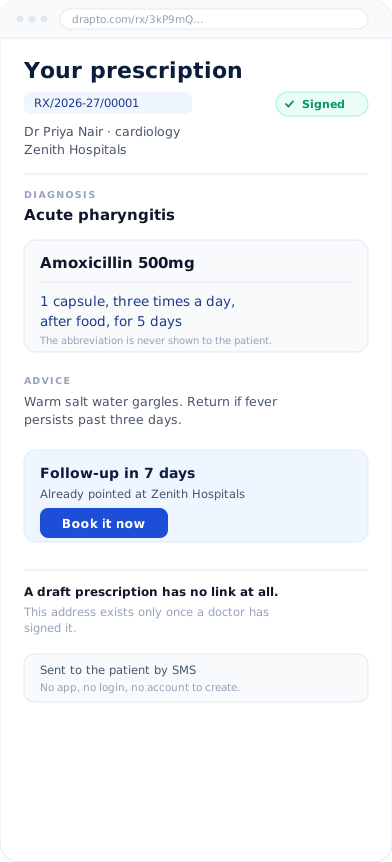
1 capsule, three times a day, after food, for 5 days
You still enter the short form. It is the printed and shared version that changes.
The five that go wrong most
Where the guess and the intention diverge.
- FrequencyTDS, BD, QID and OD are all read as “some number of times” by someone who does not know the convention. Frequency errors change the total daily dose, which is why this one matters most.
- Duration“× 5d” is often read as a quantity to buy rather than a course to finish. With antibiotics, stopping at symptom relief is the specific failure that follows.
- Relation to foodAF and PC mean nothing outside the profession, and for some medicines they change absorption enough to matter.
- SOS and PRN“As needed” without a stated ceiling invites a patient to decide the maximum themselves. If it is as-needed, the limit has to be written.
- The unit itselfTablet, capsule, millilitre, drop. Obvious to you from the formulation, not obvious to a patient holding a syrup and a spoon.
None of this is about prescribing differently. The clinical decision is yours and does not change. What changes is whether the instruction that leaves the room is the instruction the patient follows.
Two more things worth writing down
The follow-up, and the reason for the drug.
The follow-up you asked for verbally
An appointment requested in the room and not booked before the patient leaves is the one most often never made. Written on the prescription it survives the walk to the car park.
What each medicine is for
Patients stop the tablet whose purpose they cannot recall first. One phrase — for blood pressure — changes adherence at effectively no cost.
How Drapto does it
You enter TDS. The patient never sees it.
The prescription the patient opens spells the instruction out in full, carries the follow-up as a button already pointed at the right doctor, and exists only once you have signed it — a draft has no link at all. It reaches them without an app, a login or an account.
There is also an allergy check that speaks up when a prescription conflicts with something recorded, and asks for a reason rather than blocking you. It covers seven high-value drug families, not a full formulary, and we would rather name the edge of it than let anyone trust a check that is not there.
The appointment system is free. Forever.
No seat limit, no per-appointment fee, no commission on a consultation. Revenue integrity is the part we sell.