

Billed is not banked. Close the gap.
Collections Center turns outstanding balances into a prioritised worklist — bucketed by age, measured by branch and doctor, and tracked through every partial payment until the balance clears.
The screen
₹8,40,000
₹5,20,000
₹3,10,000
₹2,70,000
₹2.7LOver 90 days, never chased21 accounts
9Short-paid, no query raisedwindow closing
₹1.4LPatient balance after settlementstatement due
6Disputed, awaiting payer response18 days
₹8.4LInside 30 days, on scheduleno action
Sorted by age and by who owes it. A ninety-day balance and a nine-day balance are not the same problem.
0–30 through 90+
can action now
every part payment
for every review
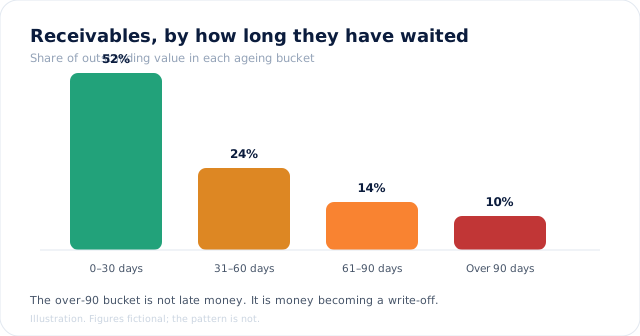
Old balances do not get harder to collect. They get impossible.
Recovery probability falls sharply with age. The difference between chasing at day forty-five and day one hundred and five is not effort — it is arithmetic, and it is the difference between most of the money and almost none of it.
Ageing that drives action, not just a report
Balances sit in four buckets — 0–30, 31–60, 61–90 and 90+ — so the front desk always knows which accounts deserve the next call. It is a worklist, not a list.
- 0–30 / 31–60 / 61–90 / 90+ ageing buckets
- Pending-payment worklists actionable today
- Recovery tracked across partial payments
- Historical ledgers retained for audits and reviews
Collection efficiency, by branch and by doctor
Collection performance is measured where it actually happens. When one branch collects at ninety-four per cent and another at seventy-eight, that gap is visible immediately rather than hidden inside a consolidated average.
- Collection efficiency by branch, department and doctor
- Partial payments recorded against the original balance
- Outstanding position visible per patient
- Ledger history preserved for every account
The agent tells you which accounts to chase first.
Ageing buckets show you what is outstanding. The Revenue Leakage Analyst goes further and ranks where recovery effort is best spent, tracing every figure back to the underlying accounts so the front desk can act on it immediately.
- Prioritises accounts by recoverable value
- Every number traceable to the original balance
- Deterministic calculation, model used only to explain
- Optional, and off unless you enable it
What changes for your team.
Money arrives sooner
A prioritised worklist means the accounts most likely to pay get contacted while they are still likely to pay.
Weak points become visible
Collection efficiency by branch and doctor turns a vague sense that "collections are slipping" into a specific, addressable number.
Front desk knows what to do
Staff open a worklist rather than deciding for themselves which accounts to chase, which is how good intentions turn into consistent recovery.
Audits stop being painful
Historical ledgers mean review requests are answered from the system rather than reconstructed from memory.
Straight answers.
Does Drapto contact patients for me?
No. Drapto produces the prioritised worklist and tracks outcomes. The conversation with the patient stays with your team.
How are partial payments handled?
Each partial payment is recorded against the original balance, so the remaining outstanding amount and the recovery history are both visible.
Can I see collections by doctor?
Yes — collection efficiency is available by branch, department and doctor.
Is old ledger data retained?
Yes. Historical ledgers are kept so audits and internal reviews can be answered from records rather than reconstruction.
Turn outstanding balances into a worklist.
Built to standards, not to a demo
Corporate contracts, without changing your system.
We find the companies and run the outreach. Your existing software stays where it is.