

Government scheme
PM-JAY claims, and where the money actually goes.
This page describes mechanisms, not conduct. We publish no settlement rate for PM-JAY and no comparison against private insurers — we have not measured one, and a number we cannot show the working for is not worth reading.
PM-JAY settles against a published rate list, not against what a hospital charges. Most shortfalls come from three places: the rate version applied, whether the referral or authorisation covered what was actually done, and evidence attached after the deadline. This page describes those mechanisms. It publishes no settlement rate for PM-JAY and no comparison with any other payer.
The package rate is a ceiling, not a price.
Under PM-JAY the package is the whole payment. Consumables, implants and the longer stay are inside it, not alongside it — which makes the question at admission a costing question, not a billing one.
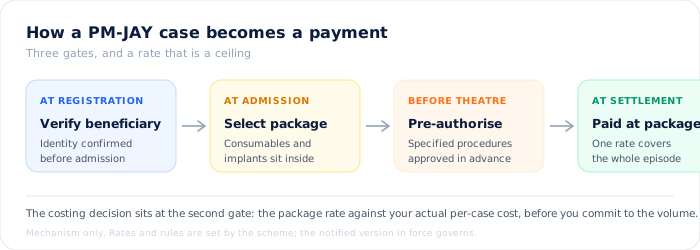
The three that decide most of it
Beneficiary verification
Identity is verified before treatment, not reconciled after it. A verification that fails at discharge leaves a case treated with no payer behind it — the single most expensive failure in the scheme.
Decided: At registration, before admission.
The package boundary
Each package specifies what it includes. Billing a consumable or an implant separately from its package is the same mechanism as unbundling on a private claim, and it is disallowed the same way.
Decided: At the point of billing.
Pre-authorisation for specified procedures
A defined list requires approval before the procedure, not after. The approval carries the package code that will be paid, which is the number worth checking against your own cost.
Decided: Before the procedure.
What we will not tell you about PM-JAY
What other sites publish
- A settlement percentage with no method behind it
- Whether PM-JAY “pays less” than private insurers
- Which scheme to avoid
- What you would earn by de-empanelling
What is on this page
- How a package rate is structured and what sits inside it
- Which failures are decided before admission
- The NABH differential, and the arithmetic behind it
- Costing you can redo with your own case mix
Whether the volume is worth it
The honest answer is that it depends on your cost per case, not on the scheme. A package that is loss-making at your consumable cost stays loss-making at volume. The calculation worth doing is package rate against your actual per-case cost, specialty by specialty — which is a costing exercise, and it is one you can do before you commit. Where accreditation lifts the rate, the differential is worth modelling against what accreditation itself costs to hold.
Questions we get asked
Is a PM-JAY package rate negotiable?
Package rates are set by the scheme, not agreed bilaterally, and are revised centrally. What varies is whether a given package covers your actual cost for that case mix — which is a costing question you can answer with your own numbers before committing to volume.
Why was a treated PM-JAY case not paid?
The commonest cause is a beneficiary verification that did not complete, which leaves a treated case with no payer behind it. Verification is decided at registration, before admission — which is the only point at which it can still be fixed.
Where the money actually goes.
Mechanism, not measurement. Neither figure below is a claim about this payer.
- Billed
- Deducted
- Settled
Every step is a named reduction with a clause behind it. None of them is a refusal, and none of them is a surprise once you know which clause applies. This shape is generic to Indian health insurance; it is not a measurement of PM-JAY.
Illustrative arithmetic. Your own figures will differ.- 58 settled in full
- 27 settled short
- 11 open past 60 days
- 4 written off
The twenty-seven in the middle are the argument. Not refused — paid less than billed, each for a stated reason.
Illustrative arithmetic. Your own figures will differ.A government scheme settles against a list
PM-JAY does not price a claim. It matches it to a published entry and pays that.
The rate list is the contract
There is no negotiation on a listed item. The only questions are which entry applies and which version of the list was in force on the date of admission.
Accreditation changes the rate
Several schemes pay a differential for accredited facilities. The accreditation status recorded in the empanelment, not the certificate on the wall, is what the claim is priced against.
Referral and authorisation define scope
The sanctioned procedure bounds the claim. A change in theatre recorded afterwards is a representation, judged differently from an enhancement recorded during the stay.
The beneficiary is not the payer
Eligibility, entitlement and ward class come from the beneficiary's card and category. Getting that wrong at admission is unrecoverable at settlement.
What actually decides the number
Four documents. The clinical file is not one of them.
The rate list, and its version
PM-JAY pays against a published schedule. A claim priced on last year's version is short by the difference, and the difference is not negotiable afterwards. Check which version was in force on the date of admission, not the date of billing.
The referral or authorisation
It states what was sanctioned. A procedure that changed, or a stay that ran longer, needs the change recorded while the patient is still admitted — not explained in a representation afterwards.
The empanelment terms
Accreditation status, the specialities covered and any ward-class entitlement all sit in the empanelment letter. They decide the ceiling before any clinical fact does.
The evidence pack
Discharge summary, investigation reports, implant invoices and the operation notes. A claim can be clinically perfect and still reduce because the invoice for the implant was not attached.
The clock, and where it runs out
Four moments. Three of them are before the money is at stake.
Before admission
Referral or authorisation obtained and on file. A retrospective one rarely repairs a claim.
During the stay
Any change in procedure, ward class or length of stay recorded while the patient is still admitted.
At discharge
The evidence pack completed before the file closes. Chasing a signature a week later is how a claim ages.
After the advice
Read the settlement within days, not weeks. Representation windows are stated in the scheme's own circular and they do not extend because nobody looked.
If the scheme's own process is exhausted
The route is published, and it is the same for every provider.
The scheme's grievance channel
Every scheme runs one, with a stated turnaround. Use it first and in writing — later stages ask what happened at this one.
The nodal or empanelment authority
Above the processing desk sits the office that issued the empanelment. Contract disputes belong there, not with the claims processor.
For a patient, not a provider
A patient facing a shortfall has a separate route, and it is not the hospital's to run for them. Sahayak explains it in plain language and names the official channel.
Questions we are actually asked
Does Drapto publish a rejection rate for PM-JAY?
No. We have not measured one, and a figure we cannot show the working for is not worth reading. We publish no settlement rate for any payer and no comparison between payers.
Why was the claim approved and still paid less?
Because approval and pricing are separate decisions. A claim can clear on clinical grounds and still reduce on a room-rent proportion, a tariff version, a sub-limit or an unattached document.
A room upgrade cost ₹8,000. Why did the settlement drop by much more?
Under proportionate deduction, exceeding a room-rent limit re-prices the associated heads on the same bill in the same ratio — surgeon, anaesthetist, theatre, investigations. The room is the trigger, not the size of the loss.
Can this be fixed after discharge?
Some of it. Most of it is cheaper to prevent: the room class at admission, the enhancement during the stay, the query inside its window. After discharge the same facts are argued instead of recorded.
The same mechanics, other payers.
- Aditya Birla HealthHow deductions happen
- Bajaj AllianzHow deductions happen
- Care HealthHow deductions happen
- CGHSHow deductions happen
- ECHSHow deductions happen
- ESICHow deductions happen
Patients: Sahayak explains a rejection letter in plain language. Hospitals: Decoder separates predictable deductions from contractual ones on a settlement advice.
See these deductions on your own settlements.
Twenty settled claims, advices only, patient details redacted. We read them with you and name the clause behind each reduction.